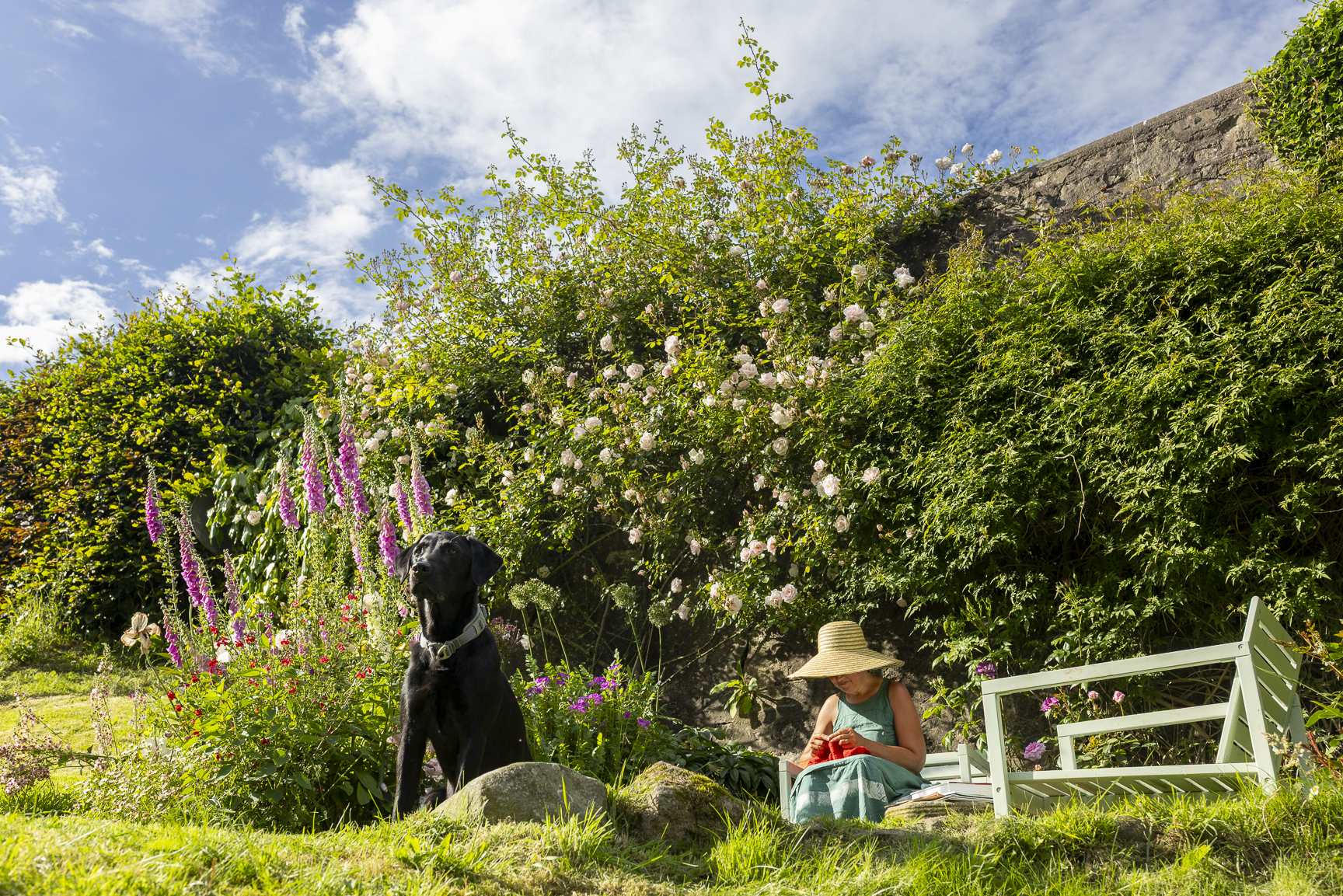
We inherited several roses in the mill garden and, never having grown them before, I’ve been trying to identify and learn about roses and their needs.

In some cases this is quite simple. “Rhapsody in Blue“, for example, is an immediately recognisable cultivar, not only because of its its open blooms of a most unusual blue-ish purple shade, but because there was a usefully retained old label in the ground, which meant I could easily identify this rose (thank you, Barry).

In other instances, discovering the mysterious name of the rose is a much more tricky process.

I strongly suspect, for example, that this beautiful shrub . . .

. . . whose tall pointed buds emerge with red edges, and whose flowers begin as deep egg-yolk yellow . . .

. . . eventually opening into huge plate-sized blooms with petals of creamy yellow, tinged with pink . . .

. . . is the famous hybrid tea which was introduced as Madame A Meilland, and which, after 1945, became known as the “peace” rose.

I also have a feeling that the huge, vigorous climber . . .

. . . beneath whose delicious scent and falling petals I love to sit and knit . . .

. . . is David Austin’s “generous gardener” .

But there are several other roses, red and white and pink – each with a different habit, flower formation, petal colour, scent – whose name has so far proved elusive.

Completely failing to discover the name of the rose has in itself been an extremely interesting process, from which I’ve learned an awful lot. In fact, it’s fair to say, that the naming of roses, as well as the growing of them, has become something of a new obsession.

As a novice rosarian, the history and nomenclature of roses can seem dizzyingly, dazzlingly confusing. For has any flower, at any point in human history, aroused quite so much fascinated attention as the rose, from its floribundas to its centifolias, its old teas and hybrid teas. What separates a “cabbage” from a “damask”, rosa canina from rosa gallica, climbers from ramblers, “shrubs” from “standards”?

This confusion is itself powerfully symptomatic of the huge amount of attention roses have accrued. Precisely because they are so beloved and so admired; because they have been so widely (and so continuously) cultivated in so many different places around the world, roses possess a unique ability to project and soak up meaning. There are countless myths about roses, and, I’ve discovered, a whole lot of misinformation too. For example, the Provins rose has nothing to do with the crusades, and the wars of the roses weren’t the wars of the roses at all (we can blame Shakespeare for the retrospective poetic license that gave us Lancashire’s red and Yorkshire’s white).

Both potent and exhausted as a symbol; simultaneously replete with human meaning, and tired, worn-out metaphor, is there anything left to say about the rose? Not for nothing is the final word uttered by Orson Welles’ Charles Foster Kane, “rosebud”, a mysterious numen full of loss and longing.

Umberto Eco apparently chose The Name of the Rose as a title for his famous 1980 novel precisely because this flower is “a symbolic figure so rich in meanings that by now it hardly has any meaning left.” I’ve been thinking about this issue a lot in recent weeks, and over the next few posts, I’ll explore a few different poetic approaches to the rose and its rich / worn out symbolism, accompanied by more of Tom’s excellent photography.
Do you have a favourite poem in which a rose appears? Tell me about it!


Leave a Reply