
Perhaps for no poet did the rose serve as a more powerful motif than Rainer Maria Rilke. As he lay dying in 1926, he composed the epitaph which was later inscribed on his gravestone:
rose, oh reiner widerspruch, lust,
niemandes schlaf zu sein unter soviel lider
rose, o pure contradiction, desire
to be no one’s sleep beneath so many lids.
(The German “lider” of that second line carrying a double meaning of songs / poems).

Among twentieth-century poets like Robert Duncan, a myth grew up around Rilke’s death, which was said to have been precipitated by an injury to his arm from the thorn of a rose:
Rilke torn by a rose thorn
blackend toward Eros
Robert Duncan “A Poem Beginning with a Line by Pindar” (1960)
In fact, Rilke had died of leukaemia, with the thorny incident long predating his final illness, but the myth certainly conveys the power of the rose as a creative symbol for this poet and his legacy.

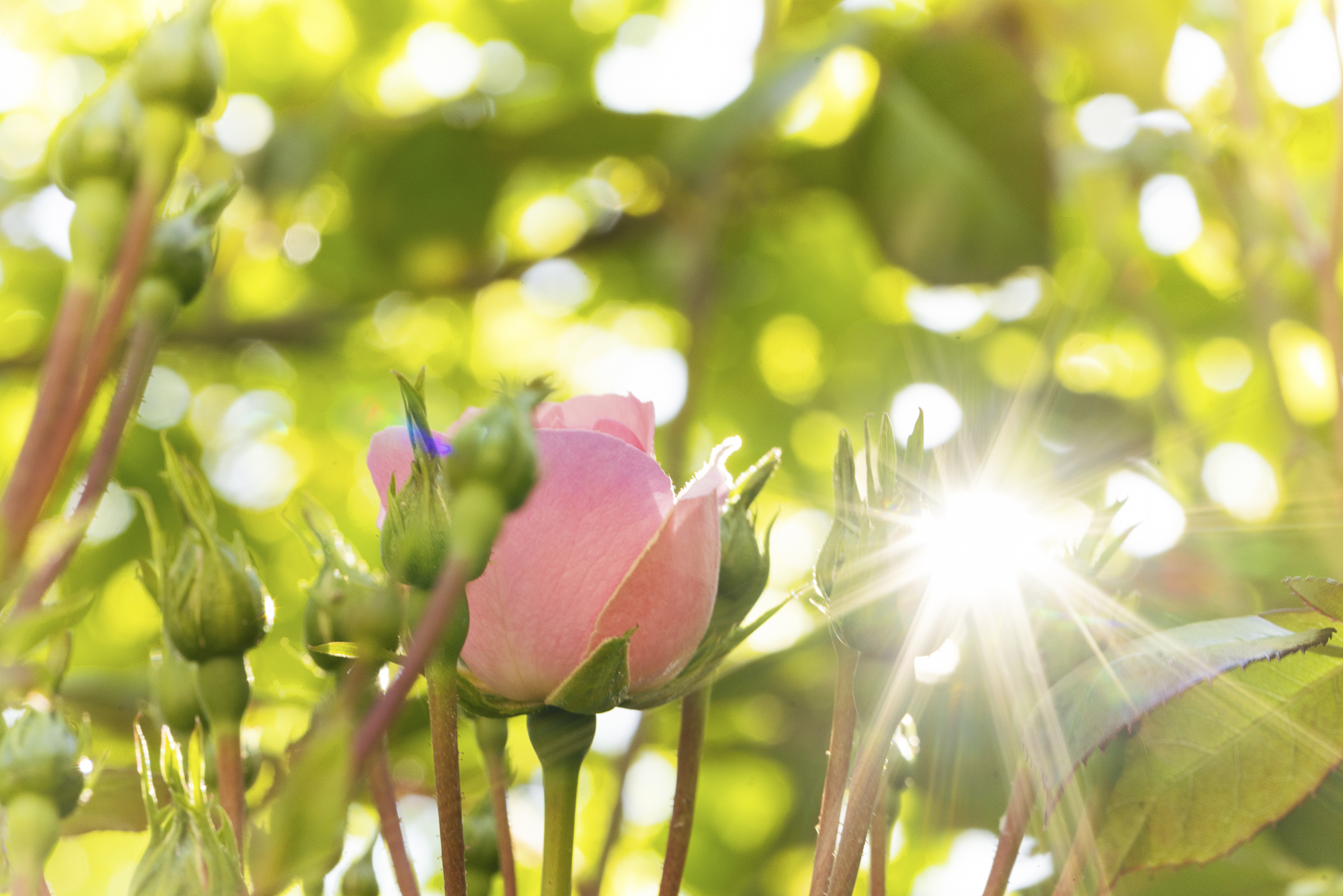
Here are some of Rilke’s roses, accompanied by some from my garden, as beautifully photographed by Tom.

II
I see you, rose, book half-opened,
having so many pages
of detailed happiness
we will never read. Mage-Book,
which is opened by the wind and can be read,
eyes shut …
from which butterflies scatter, confused
to have had the same ideas.

XIV
Summer: to be for a few days
the contemporary of roses;
to breathe what drifts about
their blooming spirits.
To make of each who dies,
a confidant,
and to outlive this sister
among the other, wandering roses

XVIII
All that we feel, you share,
yet we ignore what happens to you.
There would have to be a hundred butterflies
to read all your pages.
There are ones among you like dictionaries;
those who gather these
are tempted to bind all the pages.
Me? I like the roses which are letters.

. . . for now before you stands the bowl of roses,
unforgettable and wholly filled
with unattainable being and promise,
a gift beyond anyone’s giving, a presence
that might be ours and our perfection.

Living in silence, endlessly unfolding,
using space without space being taken
from a space even trinkets diminish;
scarcely the hint there of outline or ground

they are so utterly in, so strangely delicate
and self-lit—to the very edge:
is it possible we know anything like this?

And then like this: that a feeling arises
because now and then the petals kiss?
And this: that one should open like an eye,
to show more lids beneath, each closed
in a sleep as deep as ten, to quench
an inner fire of visionary power.
And this above all: that through these petals
light must make its way.

Out of one thousand skies
they slowly drain each drop of darkness
so that this concentrated glow
will bestir the stamens till they stand.

And the movement in the roses, look:
gestures which make such minute vibrations
they’d remain invisible if their rays
did not resolutely ripple out into the wide world.

Look at that white one which has blissfully unfolded
to stand amidst its splay of petals
like Venus boldly balanced on her shell;
look too at the bloom that blushes, bends
toward the one with more composure,
and see how the pale one aloofly withdraws;
and how the cold one stands, closed upon itself,
among those open roses, shedding all.

What can’t they be? Was that yellow one,
lying there hollow and open, not the rind
of a fruit in which the very same yellow
was its more intense and darkening juice?

And was this other undone by its opening,
since, so exposed, its ineffable pink
has picked up lilac’s bitter aftertaste?

And this of opalescent porcelain
is a shallow fragile china cup
full of tiny shining butterflies —

. . . and there — that one’s holding nothing but itself.

And aren’t they all that way? just self-containing,
if self-containing means: to transform the world
with its wind and rain and springtime’s patience
and guilt and restlessness and obscure fate
and the darkness of evening earth and even
the changing clouds, coming and going,
even the vague intercession of distant stars,
into a handful of inner life.
It now lies free of care in these open roses.

Selections from Rainer Maria Rilke, Roses (1926) translated from French by David Need (2014) and Rainer Maria Rilke The Bowl of Roses (1907), translated from German by William H Gass (1999).


Leave a Reply