This weekend, Tom and I saw A Matter of Life and Death at the Glasgow Film Theatre, as part of the BFI’s brilliant Powell and Pressburger season, which we are very much enjoying. Being generally obsessed with this film, and having written a wee bit about its innovative use of technicolor, it was wonderful to see it on the big screen, especially in this newly restored print, whose pearly clarity and gorgeous hues completely took my breath away.

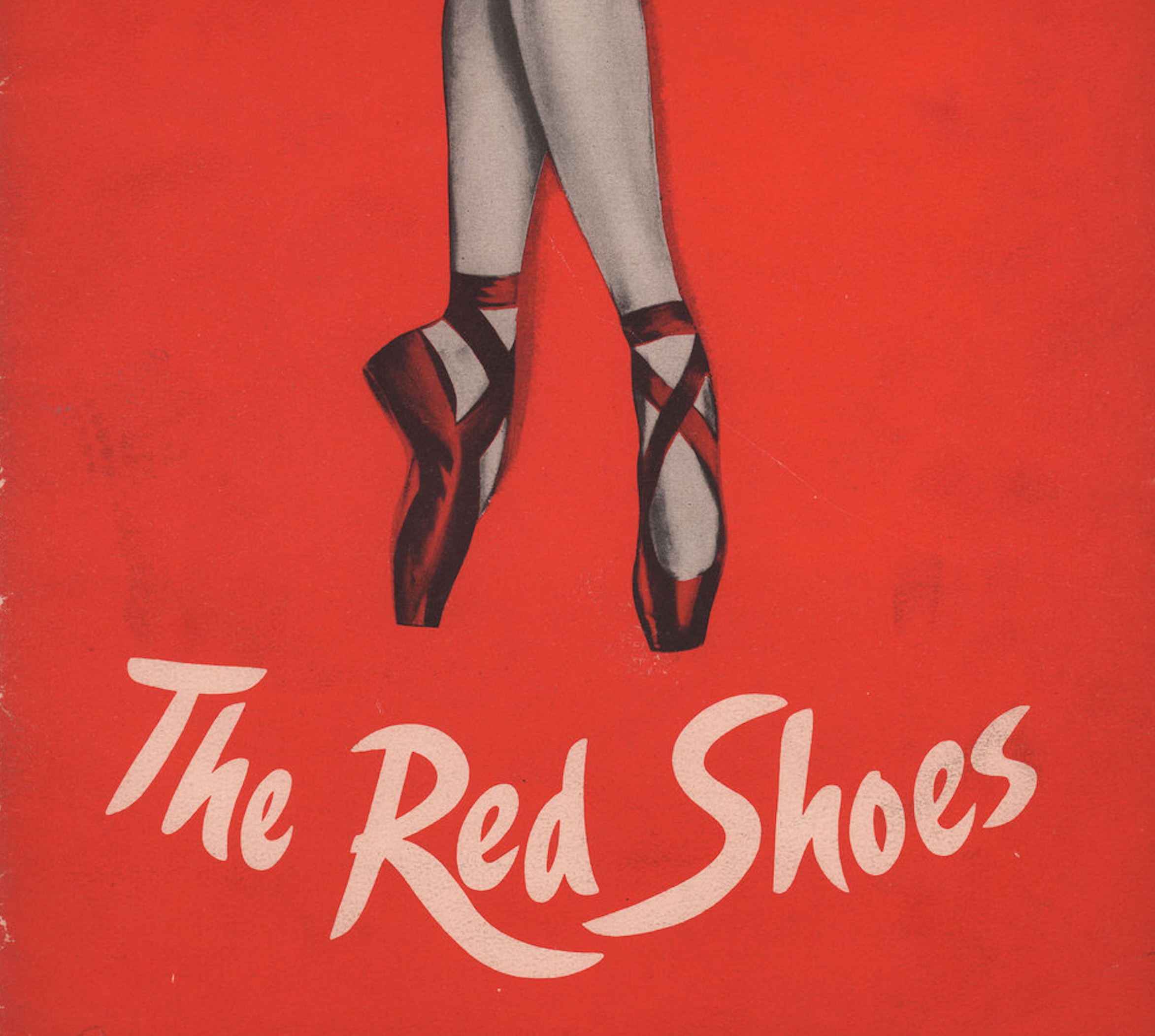
Revelling in the vivid on-screen colours of A Matter of Life and Death made me call to mind another Powell and Pressburger masterpiece, and the subject of today’s post, The Red Shoes (1948). This innovative film gathered several different creative genres together – fairy tale, ballet, theatre, narrative cinema – and combined them into a single glorious technicolor spectacle. The red shoes of the film’s title are its chromatic beating heart.

Red was a hue which really came into its own with technicolor. Not for nothing did MGM transform the silver shoes of Frank Baum’s original into Judy Garland’s iconic ruby slippers.

Charmed objects that the wicked witch yearns to possess, the ruby slippers also externalise Dorothy’s longing to return home, and act as a transporting mechanism between Kansas and Oz.

While Dorothy’s ruby slippers are obvious objects of desire and power, the red shoes coveted (and worn) by creatively-driven ballerina, Vicky Page (played by luminous, flame-haired Moira Shearer) are more symbolically ambivalent: objects of danger, enthralment, and self-destruction, as well as of desire.

To understand red’s ambivalence, we might return to its beginnings.

Michel Pastoureau describes red as “colour incarnate” – the hue of fire, blood and the body – birth and death and menstrual blood – as well as the first dyes and pigments.

In Chinese culture, red is auspicious and prestigious: the colour of good fortune and celebration.

. . .while many traditions, both east and west, associate red with pleasure, excess and sexuality – and with female sexuality in particular.

Red can be sweet or spicy, attractive or repellent. It can signify energy, enchantment, ambition, anger, pleasure, heat, violence, terror, madness, passion, transgression, revolution. . .

Red always lets us know its there. Red is a sign of warning.

Red is a super-saturated colour that tends to soak up human meaning. Red can be many things, but it can never be neutral.

In traditional fairy tales, red often acts as a premonition or pre-figuring of the violence with which the story ends.

In Hans Andersen’s original tale (from which the ballet within the Powell and Pressburger film is loosely adapted), the fulfilment of desire (in the wearing of the red shoes) ends with masochistic self-destruction (when the dancer finds she can’t stop dancing). The dance consumes the dancer, and the red shoes shift from being objects of desire to agents of self-destruction.

Powell and Pressburger’s film follows, to some extent, the familiar fairy-tale logic – Vicky’s red shoes are both eros and thanatos, desire and death – but the story (and its chromatic symbolism) is much more ambivalent, and certainly much less predictably moralistic

For Vicky’s red shoes are so many things . . .

her heart’s desire . . .

. . .and love’s denial . . .

rapture . . .

. . . and repulsion

. . . self-expression, self-possession . . .

. . . and the damaging control or containment of the self.

Perhaps most of all, Powell and Pressburger’s red shoes – captured so wonderfully by the Archers’ cinematographer, Jack Cardiff in glorious technicolor – vividly convey the tangible materiality of dance – the hard work that dance involves, the physical discipline of it, the exacting demands dance makes upon the mind and body of the dancer.

Power and desire, blood and the body, creative realisation or self-destruction, fetish or charmed object: the ambivalent allure of the red shoes has continued to fascinate creative women from Anne Sexton to Kate Bush.

Red can be many things – but it can never be neutral.
Further reading
Michel Pastoureau, Red: The History of a Colour (2017)
Nathalie Morris and Claire Smith, eds, The Cinema of Powell and Pressburger (BFI, 2023) (a highly recommended new book!)
Sarah Street, Colour Films in Britain: The Negotiation of Innovation 1900-1955 (2012)
Lesley Stern, The Scorsese Connection (1995) (an interesting and original reading, arguing that The Red Shoes and Raging Bull are essentially the same film – yes, really!)
You might also enjoy this interview with the brilliant and inspiring Thelma Shoonmaker (from Mark Kermode and Simon Mayo’s podcast )
Discover more from KDD & Co
Subscribe to get the latest posts sent to your email.

It’s so interesting that red has so many meanings and that they are so often connected to big emotions or moments. When I was growing up red was “my” colour and blue was for my sister. As far as I know this was because my hair is brown and her’s is blond and because we were very close in age and size we often had clothes that were the same except for colour. As an adult I still love red and it makes me feel powerful when I wear it but I don’t do so very often.
Red, especially in the form of a dress, is becoming strongly associated with bringing awareness to missing and murdered Indigenous women and girls in Canada (I don’t know if this is happening in other countries).
Red is also one of the hardest colors to create naturally. Until the discovery of crushed cochineal beetles from the New World, reds tended to be more muted and rarely colorfast, fading quickly. (It is also part of why the color was restricted to certain classes with the sumptuary laws. Purple being a color that needs red was especially desirable and difficult to achieve. It was reserved for royalty and certain orders of clergy).
In Women’s Work, Elizabeth Wayland Barber writes quite a bit about the symbolic meanings of red, going deep into the ideas about fertility, sexual danger/temptation, etc. The Red Riding Hood story is particularly interesting on a symbolic level, representing a kind of sexual awakening/coming of age.
In Russian, the word for red and beautiful have the same root and are sometimes used interchangeably. So Red Square in Moscow (Krasnaya Ploshad/Красная площадь) can be translated as Beautiful Square (Kracevaya Ploshad/Kрасная площадь)
I find it interesting that so much folk dress in Europe (particularly Eastern Europe and Russia) is red-based. There are these embroidered cloths in Ukraine and Russia called rushnyks that are traditionally embroidered with a technique called blackwork that uses black and red thread on a white cloth, but the symbols are typically done in red and each line of symbols means something, so with some research and practice you can “read” the rushnyks to tell you about the family that they came from, and sometimes about what they were given for (sometimes as part of a wedding dowry).
I’m not a linguist, but I’m fascinated by the linguistic theory that cultures generally developed words for black and white, followed by red (and then other colors, with blue coming relatively late). Red is not neutral – it’s so important that we need a word for it more than for other colors.
I had to smile about your opinion of red. Freddy Moran, a well-known quilt author and teacher, has always said, “Red is a neutral!” And her bright, happy quilts follow this rule.
When I was a teenager, the mother of a friend told me that I shouldn’t wear red. She said wearing red was announcing to the world that I was like Little Red Riding Hood, and that I was expecting or needing to be rescued. She grew up in Germany – is this a cultural thing there? I’ve always wondered.
I never stopped wearing red, despite her exhortation. I really like red!
In his book, Pastoureau talks about the tradition in some European countries of dressing small children in red when they were out playing, so that they could be easily spotted and kept out of harm’s way (this practice has links with the red riding hood story). Perhaps the mother of your friend retained that old association?
Possibly? Thinking back, the implication was more that I was looking for a man who would “rescue me.”
Interesting, and very clever, that bright colors were used to keep track of children. From a Chinese friend, I learned that she thought only children wore very bright colors. Adults were expected to wear more drab colors. Again, I think I was wearing red the day my Chinese friend told me that. Given her age, I’m guessing this was post Cultural Revolution tradition.
A man? Outrageous! (And offensive)
Yes. Definitely.
Again you have further enhanced my knowledge. Thank you!
A very interesting blog thank you
Always fascinating, Kate. I was reading something about how Indian weddings are going pastel now, since red is apparently so cliché. It’s sad to me that people don’t understand that wedding red is tradition, very different from cliché. The bride is always in some shade of red, auspicious, just like the sindoor (vermilion) worn in the hair parting to show marital status. White is a loss of color and fortune, the loss of a husband. That part I think we can dispense with, but I would hate for Indian weddings to lose the red.
Of course I had to be different when I got married, and instead of wearing the Tamil bride’s traditional maroon silk Kanjeevaram sari, I picked one that was six yards of phenomenal hand embroidery. It was stunning but it weighed a ton!
Wow, Deepa, your sari sounds completely stunning. You must have looked amazing! Can red ever be cliché? I don’t think so!
I am thoroughly enjoying this series of posts. Today’s is outstanding. I know I’ll be thinking about it all night and I suspect that I will soon be viewing The Red Shoes again.
I love the film The Red Shoes and back in the early 1980s was excited to learn that a work colleague had been a member of the corps de ballet in the film. Sadly she didn’t have any interesting anecdotes to tell, but it still felt like a link with greatness. The themes of the film resonate today – Will it ever be possible for a woman to combine an artistic life satisfactorily with romance or a happy domestic life?
However I find the original tale by Hans Christian Andersen deeply problematic. I read it at age 9 or 10 and was shocked, as I still am, that Karen was so severely punished simply for wanting a pair of red shoes. There was a particular dress that I was hoping my mother would make for me (she was good at copying expensive dresses in the shops or magazine pictures) I thought I wanted that dress as much as Karen wanted the shoes, and wondered if I was wicked as the story seemed to imply. Much later, I read aloud to all four of my children, but avoided several Andersen stories which seemed to wallow in something disturbingly sadistic.
I agree entirely about the cruel, sadistic turn of the moralising in the Andersen story (and many other Andersen stories!)
At the Art Collection at the University of Stirling this (academic) year, we have curated an exhibition with the theme title ‘Inspired!’ which features many red paintings from the permanent collection., inspired by one entitled ‘Cadmium and Light Red’ by Patrick Heron. It felt somehow much more problematic/difficult organising this and we were not sure how it would be received (compared with for instance an exhibition entitled Blue a few years back which was much more soothing!) but it has had many favourable comments already. You are welcome to visit!
This sounds brilliant, Fiona – thank you
Kate, I love the focus of your post. It reminds me of the person I used to be
I saw this film as a young girl and all I remember is the death at the end. ARGH
When in high school I had a pair of red Capezio flats that I adored. I remember thinking that when I am 80 I shall wear red shoes. As I’m but a few years off that target it’s time to go shoe shopping. Thanks for the reminder.
hurrah!
Mary I’m of a similar vintage – maybe we should go shopping together – haha!
In Inuktitut (the language of Inuit, where I live) lots of colours have different names in different regions, but red is always aupaktuq or something close. Auk means blood and the connection is explicit.
fascinating!