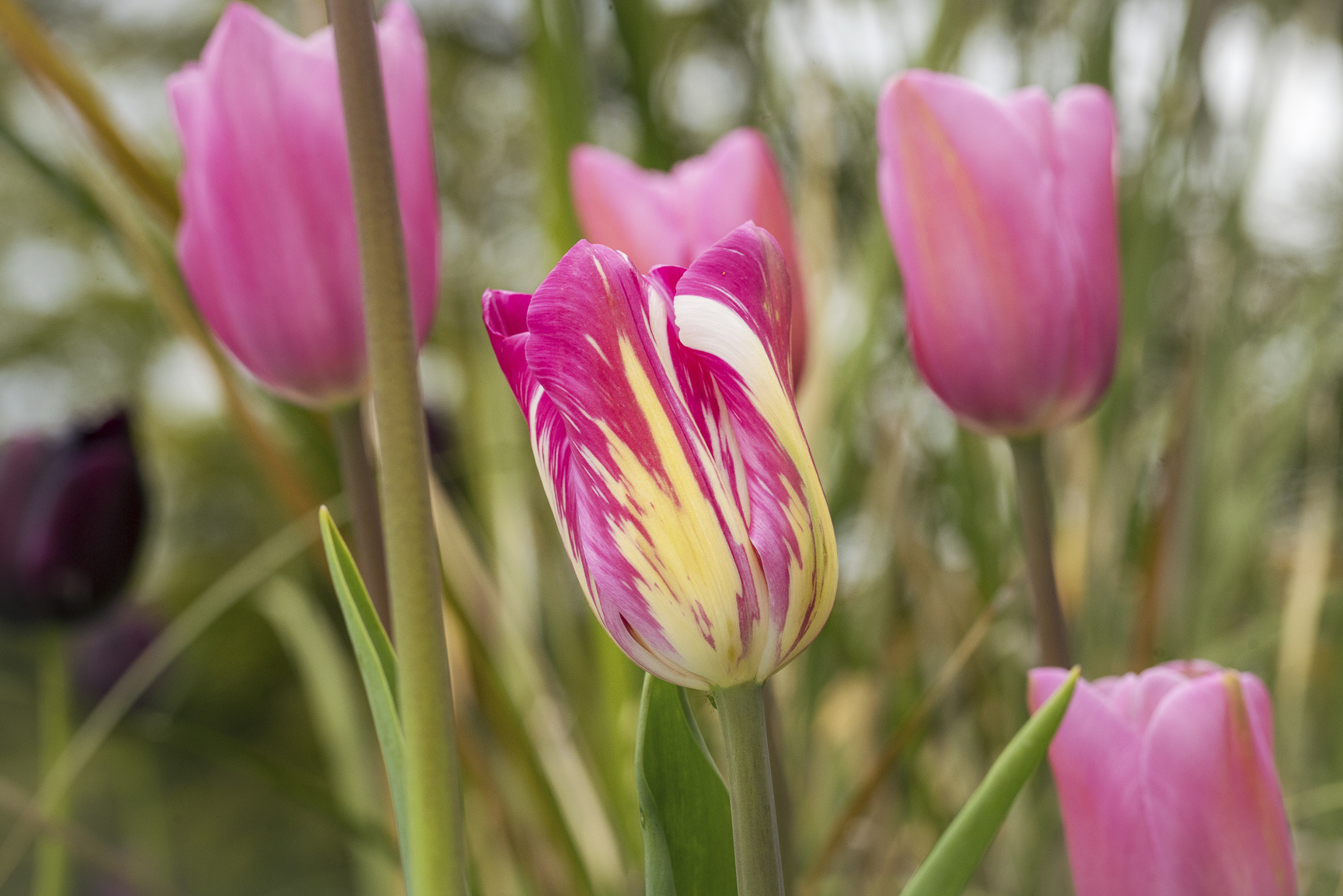
“Come quickly,” I said to Tom, “and bring the camera. We’ve got a broken tulip.”

A close-up of a pink and white striped tulip with a blurred green background.

“a broken tulip?”

“Yes! A broken one! Just check it out!”

“Hmm. It certainly looks like a freaky tulip”

“It is freaky! In fact, a tulip that has broken in this particular colour combination is actually known as a bizarre.”

Close-up of a tulip flower with pink and yellow streaks against a blurred green background.

“So it’s broken. And bizarre?”

“You’ve got it”

Close-up of a pink and yellow striped tulip bud against a blurred green background.

My “bizarre”, “broken” tulip should, believe it or not, really look like this:

A close-up of a pink tulip flower against a blurred green background.

This is a “mistress” tulip: a cultivar which is regarded as a reliable perennial and of which I planted 50 last November in the garden. It’s a late flowering “triumph” cultivar with soft pale-to-mid-pink colouring, and while 40-odd are now blooming true to type, one of them has popped up looking like this:

A close-up of vibrant pink and white striped tulips surrounded by green foliage.

Observing the stark differences between the vivid colouring of the freaky tulip and the markedly more subdued hues of its fellows you might assume that a rogue bulb of a different variety has somehow crept into my package (as can sometimes be the case), but that is not what has happened here.

Close-up of a pink and yellow streaked tulip flower bud.

No, these shouty rhubarb and custard colours are in fact the result of a virus (Tulip Breaking Virus, or TBV), which is spread by aphids, and which has infected this individual bulb.

Close-up of a pink and yellow tulip petal with striking patterns and textures.

TBV affects the coloration of tulip petals, generating a characteristic mixture of fading and intensification. In this example, pink anthocyanin pigment has gathered and become more saturated around the petal edges, while in other areas the triumph tulip’s base colour (a creamy yellow) shows through to the surface.

Close-up of a pink and yellow striped tulip petal, showcasing its delicate texture and vivid colors.

Beside its uninfected fellows whose pigment quota has been distributed uniformly across each petal in a wash of dusky pink, this single infected tulip shouts “look at me” with its streaky high-contrast saturation. And it was precisely this shouty, “look at me” quality that made TBV such an important contributing factor to the tulipmania which gripped the Netherlands in the 1630s.

A detailed illustration of various tulips, featuring distinct colors and patterns, along with a small pink flower and insects, set against a plain background.
Jacob Marrel, tulips, c. 1640. Rijksmuseum Collections

On his Heemstede estate, Dr. Adriaen Pauw grew the fabled Semper Augustus cultivar, increasing impressions of the flower’s abundance (and his own wealth) with strategically placed mirrors. While hundreds of tulips appeared to stretch out before the viewer, Pauw’s garden in fact contained a relatively small number of the prized blooms: in 1624, only a handful of Semper Augustus bulbs were known to exist, and this rarity of course increased the tulip’s value.

A detailed illustration of a red and white tulip with green leaves, signed by Jan Simonis.
Jan Simonse tulip catalogue (1640s). Norton Simon Museum.

Each of those bulbs commanded a price of 1,200 florins in 1624. By the following year, that figure had more than doubled, and at the height of the bubble, the asking price for a single Semper Augustus bulb had reached 13,000 florins. Streaky tulips were expensive because they were very rare, and they were rare because they were infected with TBV, a virus which significantly weakens the plant as well as affecting its pigmentation. But, in the 1630s, of course, gardeners like Adriaen Pauw did not understand this.

A detailed illustration of a red and white striped tulip flower with green leaves and a slender stem.
Semper Augustus tulip from Jan Simonse tulip catalogue (1640s). Norton Simon Museum.

The poor health and low propagation rate of streaky “broken” tulips compared to their solid-hued “unbroken” cousins baffled enterprising bulb growers, whose vain attempts to solve this horticultural conundrum involved many unconventional methods, such as the application of brightly-coloured paints and dyes directly to the soil. Not until 1928, in fact, was TBV identified and understood, thanks to the efforts of Sri-Lankan / British scientist, Dorothy Mary Caley.

A detailed illustration featuring a striped tulip flower in the center, flanked by two sprigs of foliage with small yellow flowers on the left and a green branch with white blossoms on the right. Two decorative seashells are positioned at the bottom of the image.
Tulip watercolour attributed to Maria Sibylla Merian (1657 – 1717). Rijksmuseum Collection

When Caley began her work at the John Innes Centre in the 1910s, the unpredictable “breaking” of some tulips into high-contrast two-tone colour remained a horticultural puzzle, although scientific knowledge was gradually accumulating about plant viruses, which were spread by insects, creating “mosaic” variegation in their hosts. When Caley began her tulip work, she was searching for proof that “breaking” tulips were affected by such a virus, and she achieved this by by grafting “broken” bulbs onto unbroken stock, effectively spreading the infection. Caley published her findings in Annals of Applied Biology in 1928 and 1932, and the mystery of the broken tulip, with its irregular yet aesthetically pleasing pigmentation, was finally solved!

A vintage botanical illustration of two tulips with colorful petals, displayed side by side, featuring detailed green leaves.
Mary Moser, Tulip Study, 1770. Victoria and Albert Museum.

Today, tulips which have been affected by TBV are banned from commercial cultivation. Bulb growers understandably value the health, reliability and predictability of their stock, and an unhealthy, streaky oddball — however interesting its colouring–might ruin years of dedicated cultivation and investment. But tulips of a two-tone, feathery, or streaky appearance are still highly prized by gardeners, and hundreds of different modern cultivars, displaying many different patterns – each much more stable and predictable than the highly irregular, streaks flames and feathers that are characteristic of tulips infected with TBV – have been developed, grown and sold.

Close-up of a purple and white tulip flower with soft petals.
Rem’s favourite

I’ve planted many such cultivars in my garden this year, and, since the beginning of April they have been for me a source of daily floral delight.

A cluster of purple and white tulips in bloom, showcasing their vivid colors and unique petal patterns.
Rimini (back) and Flaming flag (front)
Close-up of a yellow and white tulip bud with delicate petals, surrounded by green leaves.
Angel’s Flame
A close-up shot of colorful tulips featuring purple and white striped flowers alongside yellow tulips, with green leaves, set against a blurred background.
Rem’s Favourite and Angel’s Flame
Close-up of pink tulips with vibrant red and orange streaks, surrounded by green foliage.
Pretty Princess – an interesting compact variety
Close-up of a light purple and white striped tulip petal, showcasing its delicate texture and intricate details.
Flaming Flag
A cluster of white and pink tulips with delicate petals, surrounded by green leaves.
Kyoko Takahashi – dreamy and gorgeous
Close-up of a pink and white tulip bud with a smooth texture against a blurred background.
Candy Club
A cluster of vibrant purple and white tulips in full bloom.
Alexander Pushkin
A cluster of colorful tulips, including pink and purple varieties, growing beside a large, round stone in a garden setting.
Tulip selection at the front of the house

But somehow none of these cultivars, each beautiful and distinctive in its own right, beats the weird rhubarb and custard wonkiness of my single, broken bloom.

Close-up of a pink and yellow striped tulip blossom.
historically, broken tulips with a yellow base and pink or red striation were known as”bizarres”

But what do I do with my rogue tulip? Since it is entirely possible that this broken bulb will infect – and therefore weaken – its surrounding fellows, I am left with a conundrum. . . . what would you do? Leave it as it is and see what happens next year, or remove the bulb, after flowering? Please let me know in the comments!

Close-up view of colorful tulips in various shades, captured from below, with a blue sky and a stone wall in the background.

Read more about tulipmania in Anna Pavord’s excellent The Tulip (1999). For tulip-growing advice and inspiration I heartily recommend Polly Nicholson’s The Tulip Garden (2024).


Discover more from Kate Davies

Subscribe to get the latest posts sent to your email.


Comments

63 responses to “a broken tulip”

  1. Anne Carlaw Avatar
    Anne Carlaw

    Remove the bulb, replant it in it’s own pot and see what happens next year

  2. Lieska Twickler-Ester Avatar
    Lieska Twickler-Ester

    Dear Kate,Thank you so much for sharing this highly interesting and educative story. I’m Dutch, but I didn’t know the story of the broken tulips, so your telling us about the one

  3. The bizarre broken tulip is gorgeous. As others have suggested perhaps transplant it to a pot and see what happens.

  4. Elaine in NYC Avatar
    Elaine in NYC

    Fascinating that a virus creates such beauty. I’d take a chance to se whaat happens next year. The drawn illustrations were beautiful, too.

  5. Kitty Martin Avatar
    Kitty Martin

    Leave it as it is and see what happens next year. This is your only chance for a unique experiment! Gorgeous tulips.

  6. cbreezes11 Avatar
    cbreezes11

    Such lovely colors Kate – all of them. I really like the \”broken\” color and didn\’t realize it was caused by aphids! Thank you for that bit of knowledge. We can\’t seem to grow tulips here in my Cape Cod yard – the squirrels dig up the bulbs and eat them! Sue Sharpe

  7. Alice Wood Avatar
    Alice Wood

    Remove and plant in a pot so you can still enjoy it if it comes back

  8. meherun Avatar
    meherun

    wow i never knew any of this and assumed the tulips that i see with the TBV is just another normal variation. this is greatly insightful in regards to history, botany, and human behaviours. i hope you conduct some isolated experiments on these and i will be looking forward to knowing more to bloom my mind further! much appreciated <3

  9. Desiree Frutos Aparicio Avatar
    Desiree Frutos Aparicio

    Desconocía todo lo que cuentas de los tulipanes. Me ha parecido muy, muy interesante. Y las fotos son preciosas.
    Gracias por compartir 🙏

  10. Isobel (wellwoman123 on IG) Avatar
    Isobel (wellwoman123 on IG)

    I just love the little hooligan tulip. Maybe separate it from its mates and move to its own little patch. I’m hoping you capture the beauty of your garden in knitwear designs. I quite fancy a tulip sweater and socks lol

  11. Alice Avatar

    Hello, if your beautiful tulip is infected then I would use it as a cut flower, pulling up the bulb along with the flower stem and enjoy it in your home. You could also dry it ….

  12. Isobel Wrdton Avatar
    Isobel Wrdton

    Your knowledge amazes me. Something broken that’s very beautiful

  13. Dianne Barry Avatar
    Dianne Barry

    Fascinating!
    If you don’t want it to infect the others pick, including the bulb, and enjoy it in a vase.
    Thanks for such an interesting post.
    Dianne

  14. Donna Avatar

    I never realized these wonderfully unique pops of color were broken/infected bulbs.
    While I would be tempted to let it be, I think I would most like to see it replanted in a safe, separate bed with a selection of bulbs of all different colors and let nature take its course. It would be like a little surprise every year they are able to bloom.

  15. Carla Calvi Avatar
    Carla Calvi

    Given I am particularly fond of viruses and their capacity of wrecking havoc to DNA and RNA I myself would keep it. Perhaps as soon as the flowers were spent, repot, with its closest possibly infected neighbors if the virus is a soil/water borne one and isolate it from its possibly uninfected siblings and see if it will come back next year.

  16. Jennifer Lapray Avatar
    Jennifer Lapray

    Kate, isn’t it wonderful that something “broken” can be so beautiful? Aren’t we all broken in some fashion? I find it very heart warming that maybe my brokenness can be beautiful in some way, too. I would leave the broken tulip be. If it affects others, enjoy them for the years they bloom and then plant more when needed.
    Jenn

  17. Connie Flynn Avatar
    Connie Flynn

    Tulip magic !

    If you love tulips you will love the tulip beds in Norfolk, the colour is fantastic! –
    https://www.norfolktulips.co.uk/

    Best wishes
    Connie

  18. Patricia A King Avatar
    Patricia A King

    A delightful post. Enjoyed reading this very much. Thank you and Happy Spring

  19. Carolyn Avatar
    Carolyn

    I think I would have to leave it and take my chances on having a few years of weaker blooms, just to see this beauty again. After they have died out I could always plant a different cultivar!

  20. I would leave it, letting nature, not human intervention take its course. And thank you for the wonderful history lesson!

  21. Wow! I had no idea of such things! It is so beautiful (as are all of your examples).

    Is it possible to isolate it from the others? I didn’t understand…. Will it only spread to other flowers from aphids moving plant to plant? Can you just treat to kill the aphids?

  22. Judith Goulding Avatar
    Judith Goulding

    It’s absolutely beautiful, and I would definitely leave it, Kate! Let it enjoy it’s varied neighbours! That sort of wonky beauty would not be unpleasant to see elsewhere!

  23. Sandra Wellington Avatar
    Sandra Wellington

    Fascinating account of the reason for this beauty. Could you plant it singly elsewhere so that it does not infect your other tulips?
    There’s a metaphor here, that imperfection can cause such a lovely thing.

  24. Kathleen Reichenbach Avatar
    Kathleen Reichenbach

    As beautiful as it is, knowing that it will weaken the others, I would dig it up. But truly enjoy the show while it lasts. 🌷🩷

  25. Katrin Avatar

    What a beauty! I would dig it out and plant it in an extra pot, away from the other tulips.

  26. Duncan Simms Avatar
    Duncan Simms

    What a lovely email – thanks Kate!

    Something of an amateur horticulturalist myself, and delighted to learn something new!

    Duncan

  27. Debbie McPhillips Avatar
    Debbie McPhillips

    Thank you for educating us! I will be looking for broken, beautiful tulips everywhere now!

  28. Rebecca H Avatar
    Rebecca H

    Love your gardening adventures! I would recommend removing her to an isolated spot away from your others (if this can safely be done). This is one beautiful tulip, too bad it can wreak havoc with the rest of your ladies. Isn’t Spring rejuvenating!!

  29. christinewidgren Avatar
    christinewidgren

    Now I know why I\’ve always loved freaky!

  30. Hi Kate,
    Great essay! I had no idea that those “unique” tulips were part of a virus. Your tulips are beautiful. It would be a shame to potentially infect your gorgeous healthy blooms with this one, beautiful as it is. I would probably remove it and put it either on its own in a pot or with other non tulip blooms or greenery that wouldn’t be affected by this one.

  31. Katherine Parish Avatar
    Katherine Parish

    Some plant viruses (many) spread through the soil and contaminate it for years, sometimes hundreds. You might want to dig that one up and replace the soil around it.

  32. gracefullycollective25ea52bfbc Avatar
    gracefullycollective25ea52bfbc

    Ha ha, I took one look and thought Tulip mania! Yes it is quite a story. Since I am a foodie the thought of custard and rhubarb was perfect! Can you not separate it from it mates and plant it in it\’s own special pot? Or would that be too risky. Love the Angel Flame. be well, Me Thistle be a beautiful day! While there is tea there is hope! ________________________________

  33. Jenny Swanson Avatar
    Jenny Swanson

    Gorgeous post. Have you read Anne Goldgar’s Tulipmania? It’s very interesting.

    1. I have just ordered this book! Really looking forward to it

  34. Susan Korthof Avatar
    Susan Korthof

    Such a beautiful darling flower! I would cherish this ‘accident’, leave it where it is and see what happens next year!

  35. Nancy Lykins Avatar
    Nancy Lykins

    Your “bizarre” tulip is so beautiful even if imperfect. Can it be moved to a spot away from others and allowed to return next season? Likely a seriously uninformed suggestion but I enjoyed seeing its beauty so much as well as reading the history of “broken” tulips. Thanks so much.

  36. Leslie Maddock Avatar
    Leslie Maddock

    I would move the bulb to a pot away from any other tulips. (Maybe spray with neem oil to try to kill the offending aphids?) If it grows for you next year, great! If not, at least you gave the bulb a chance to flower again, while isolating the infection. Gorgeous photos!

  37. Sandra A Boyd Avatar
    Sandra A Boyd

    Hi Kate. Loved reading your piece about broken tulips. My thought would be to pot it up and keep it – it’s treasure – ,especially if you have a garden building to put it in away from the rest and potentially little aphids. This year I am beginning a dedicated veg garden below my grown “orchard” of new fruit trees. Seeing your tulips and reading about he tulip cultivators was a joy so thanks for sharing. Vest wishes for all you do. Sandra

  38. Chris Cook Avatar
    Chris Cook

    I think I would let it finish blooming, then carefully dig the bulb back up and sequester it somewhere else in your garden, so it can continue to flourish for as long as it’s able, while being less of a danger to its siblings.

  39. Stephanie Kirste Avatar
    Stephanie Kirste

    Wonderful entry. I would photograph / document this broken beautiful tulip. Knowing it is in the interest of the preservation of the flock – remove it….. with a heavy heart.

  40. Laurel Kelsey Avatar
    Laurel Kelsey

    Thank you for this beautiful article. I would keep the broken tulip and isolate from the others alone or with 2 or 3 others; it is too beautiful to deny but not allow to weaken all the tulips.

  41. I say leave it and wait for next year\’s surprise! Tulips are so amazing and every year I say I want more in my garden then since the local garden centers have the same ol same ol nothing gets purchased. Those companies that send the catalogs and have websites are another thing altogether. This year I just might have to buy some of the fancier ones.  At a previous house I had several varieties and not just the traditional red, yellow and orange like the majority of mine are. I bought those from the neighbor\’s daughter for her school fundraiser. Good cause, though.

                            Susan K Powell SchutzHappy member of the Susan Sisterhoodhttps://susansknitting.com/

  42. Yowza! I want to knit them all! Still vacillating on an opinion for the fate of the breaker. I wonder if their is a safe distance from the majority for transplant? Maybe surround the transplant with something the aphids can’t bear to leave. Also – I had no idea one could graft a bulb.

  43. Irene harrison Avatar
    Irene harrison

    It is beautiful and I would leave it. But I’m not an expert, I just love tulips. My favourites are Parrot tulips, and especially Estella Ryjnfeld. I also love T. Ballerina – it smells wonderful. Ut I haven’t been able to get any bulbs for several years.
    Good luck with your dilemma. And thank you for your story.

  44. Hmmm, conundrum indeed. Will the bulb remain infected and come up the same next year, will it die off or come back next year in all its deliciousness?
    Sending you down another rabbit hole, there is a wonderful song by Jesca Hoop called ‘Tulip’ and it tells the tale of a tulip growers daughter. Very much a fantastical story but beautiful. Enjoy

  45. Claudia Campbell Avatar
    Claudia Campbell

    Move that rogue bulb to an isolated area away from all the others. See if it survives and/or multiplies where it can do no damage to your healthy cultivars.

  46. Shirra Avatar

    It’s so beautiful! I would isolate it and see what happens with it next year.

  47. fascinating to read, and again, very well illustrated!

  48. Sharon Warden Avatar
    Sharon Warden

    Lucky you! I’d remove it & put it in a pot with a pal or two and see if it can survive and slowly hopefully grow a wee community in its pot. I read Anna’s book too which helped horticulturally explain the novel “Tulip Fever”. I sense some “freaky” inspired knitting may follow soon….

  49. JuneG Avatar

    I might pot it up, or I might just leave it…but I wouldn’t get rid of it.

  50. Karen Goward Avatar
    Karen Goward

    Hi Kate,
    I’d isolate it in its own pot! We made a lovely display on our outdoor table with a clump of daisies and forget me nots that had self seeded in the veg patch.
    Enjoy your blooms! Karen

  51. Jennifer Clark Avatar
    Jennifer Clark

    Does the virus travel far from tulip to tulip, or only to close neighbours in the ground? I wouldn’t want it to infect the other bulbs in its family, alternatively I’d love to see what happens next year. How about potting it up in a pot with a few of the “triumph” cultivars?
    I do so enjoy reading about your garden adventures.

  52. Beth Bauman Avatar
    Beth Bauman

    I believe I would remove the spent bulb and move it with some of its surrounding sisters to a separate pot then see how they all get along next spring.

  53. Piroska Sipos Avatar
    Piroska Sipos

    Nagyon tetszik az alapos történetleírás! Sok új információval lettem gazdagabb. Szépséges ez a fertőzött tulipán, így azt javaslom, vedd ki a földből hogy ne fertőzze meg a többit, és ültesd át cserépbe.
    Talán jövőre is ilyen “bizarr” lesz!

  54. Maribeth Kelly Avatar
    Maribeth Kelly

    Fascinating information
    Thank you

  55. Personally I would leave it and see what happens

  56. Elayne Avatar

    Put it in a pot with a friend of regular colour. Keep them alive somewhere sage…after all the little custard rhubarb has already made it this far … watch them. Water them. Feed them. See what happens. What a wonderment for you to enjoy.

  57. Andrea Ozment Avatar
    Andrea Ozment

    It’s so lovely, I would give it a big pot of its own and see what happens next year.

  58. Alysia Hayman Avatar
    Alysia Hayman

    No dilemma whatsoever…leave it where it is and let that gorgeousness infect others to have mass bizarres….I love it 🥰

  59. Margot Avatar

    Dear Kate,

    This is such a beauty!! I would label it with a string or something. As soon as it has stopped flowering – gently dig it up, plant it either in a pot or somewhere in your garden where it can do no harm. But please save it. It\’s too gorgeous!

    Margot

  60. Mary Charlton Avatar
    Mary Charlton

    I would remove it to another part of the garden which is tulip free and see what happens.

  61. Ive learned more about tulips in this blog than anywhere else in my life.
    There’s definitely a sermon in there about being broken and beautiful.
    I know that flowers are one of the most common motifs in design, but I hope you tackle this evergreen (hoho) topic in your own unique way one of these days.

Leave a Reply to Sandra A Boyd Cancel reply

Your email address will not be published. Required fields are marked *