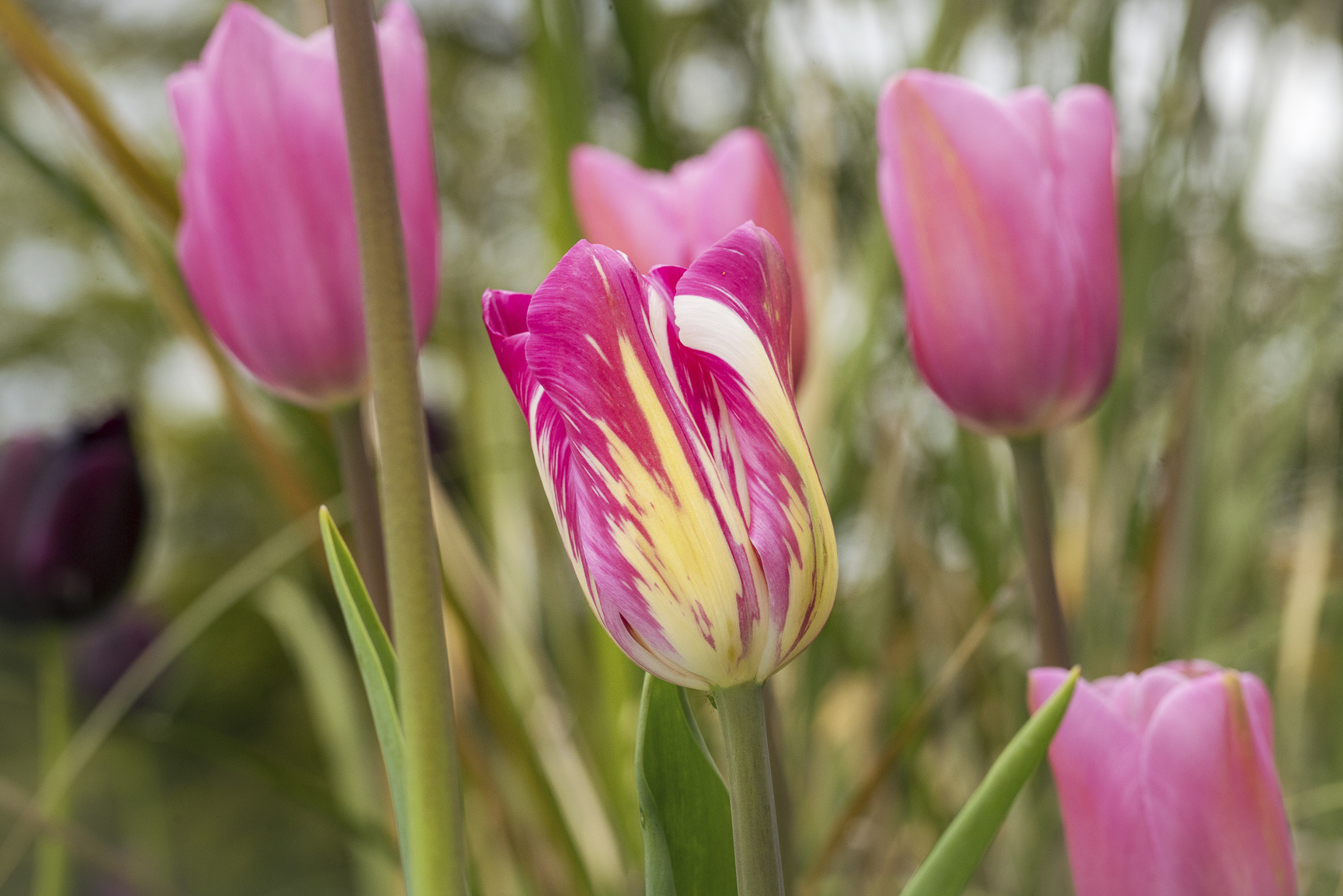
“Come quickly,” I said to Tom, “and bring the camera. We’ve got a broken tulip.”

“a broken tulip?”
“Yes! A broken one! Just check it out!”
“Hmm. It certainly looks like a freaky tulip”
“It is freaky! In fact, a tulip that has broken in this particular colour combination is actually known as a bizarre.”

“So it’s broken. And bizarre?”
“You’ve got it”

My “bizarre”, “broken” tulip should, believe it or not, really look like this:

This is a “mistress” tulip: a cultivar which is regarded as a reliable perennial and of which I planted 50 last November in the garden. It’s a late flowering “triumph” cultivar with soft pale-to-mid-pink colouring, and while 40-odd are now blooming true to type, one of them has popped up looking like this:

Observing the stark differences between the vivid colouring of the freaky tulip and the markedly more subdued hues of its fellows you might assume that a rogue bulb of a different variety has somehow crept into my package (as can sometimes be the case), but that is not what has happened here.

No, these shouty rhubarb and custard colours are in fact the result of a virus (Tulip Breaking Virus, or TBV), which is spread by aphids, and which has infected this individual bulb.

TBV affects the coloration of tulip petals, generating a characteristic mixture of fading and intensification. In this example, pink anthocyanin pigment has gathered and become more saturated around the petal edges, while in other areas the triumph tulip’s base colour (a creamy yellow) shows through to the surface.

Beside its uninfected fellows whose pigment quota has been distributed uniformly across each petal in a wash of dusky pink, this single infected tulip shouts “look at me” with its streaky high-contrast saturation. And it was precisely this shouty, “look at me” quality that made TBV such an important contributing factor to the tulipmania which gripped the Netherlands in the 1630s.

On his Heemstede estate, Dr. Adriaen Pauw grew the fabled Semper Augustus cultivar, increasing impressions of the flower’s abundance (and his own wealth) with strategically placed mirrors. While hundreds of tulips appeared to stretch out before the viewer, Pauw’s garden in fact contained a relatively small number of the prized blooms: in 1624, only a handful of Semper Augustus bulbs were known to exist, and this rarity of course increased the tulip’s value.

Each of those bulbs commanded a price of 1,200 florins in 1624. By the following year, that figure had more than doubled, and at the height of the bubble, the asking price for a single Semper Augustus bulb had reached 13,000 florins. Streaky tulips were expensive because they were very rare, and they were rare because they were infected with TBV, a virus which significantly weakens the plant as well as affecting its pigmentation. But, in the 1630s, of course, gardeners like Adriaen Pauw did not understand this.

The poor health and low propagation rate of streaky “broken” tulips compared to their solid-hued “unbroken” cousins baffled enterprising bulb growers, whose vain attempts to solve this horticultural conundrum involved many unconventional methods, such as the application of brightly-coloured paints and dyes directly to the soil. Not until 1928, in fact, was TBV identified and understood, thanks to the efforts of Sri-Lankan / British scientist, Dorothy Mary Caley.

When Caley began her work at the John Innes Centre in the 1910s, the unpredictable “breaking” of some tulips into high-contrast two-tone colour remained a horticultural puzzle, although scientific knowledge was gradually accumulating about plant viruses, which were spread by insects, creating “mosaic” variegation in their hosts. When Caley began her tulip work, she was searching for proof that “breaking” tulips were affected by such a virus, and she achieved this by by grafting “broken” bulbs onto unbroken stock, effectively spreading the infection. Caley published her findings in Annals of Applied Biology in 1928 and 1932, and the mystery of the broken tulip, with its irregular yet aesthetically pleasing pigmentation, was finally solved!

Today, tulips which have been affected by TBV are banned from commercial cultivation. Bulb growers understandably value the health, reliability and predictability of their stock, and an unhealthy, streaky oddball — however interesting its colouring–might ruin years of dedicated cultivation and investment. But tulips of a two-tone, feathery, or streaky appearance are still highly prized by gardeners, and hundreds of different modern cultivars, displaying many different patterns – each much more stable and predictable than the highly irregular, streaks flames and feathers that are characteristic of tulips infected with TBV – have been developed, grown and sold.

I’ve planted many such cultivars in my garden this year, and, since the beginning of April they have been for me a source of daily floral delight.


But somehow none of these cultivars, each beautiful and distinctive in its own right, beats the weird rhubarb and custard wonkiness of my single, broken bloom.
But what do I do with my rogue tulip? Since it is entirely possible that this broken bulb will infect – and therefore weaken – its surrounding fellows, I am left with a conundrum. . . . what would you do? Leave it as it is and see what happens next year, or remove the bulb, after flowering? Please let me know in the comments!

Read more about tulipmania in Anna Pavord’s excellent The Tulip (1999). For tulip-growing advice and inspiration I heartily recommend Polly Nicholson’s The Tulip Garden (2024).


Leave a Reply