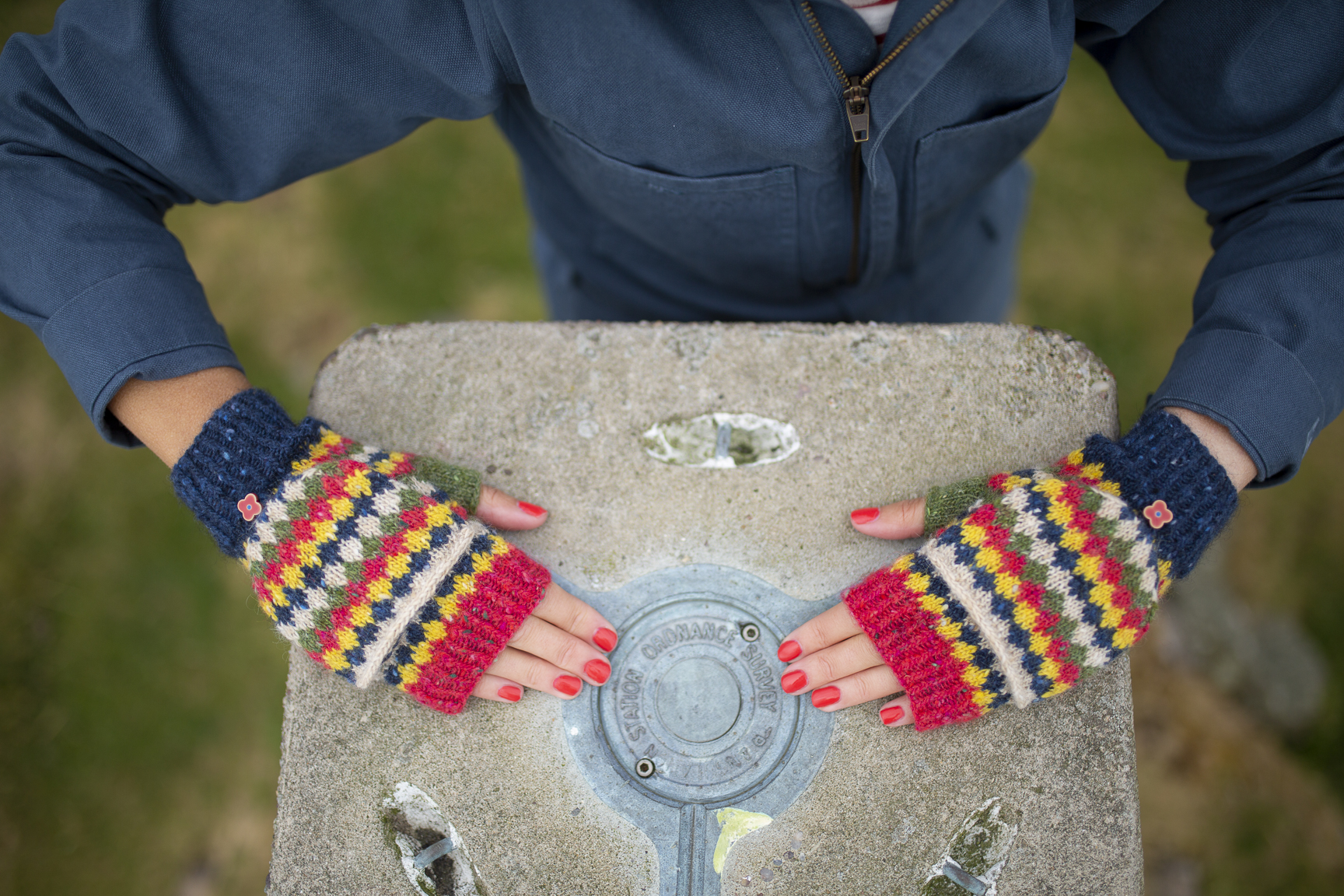

Here I am, at Davaar’s highest point, with today’s design and a trig station. What’s a trig station, I hear you ask?

You’ll know, if you were involved in our Argyll’s Secret Coast project, that I enjoy the history of maps and mapping. Trig stations – or trig points – were crucial to the mapping of the modern British landscape.

A government project on an immense scale saw the erection of concrete pillars – just like this one – atop prominent landmarks and hills. The first pillar appeared in 1936, and in the months that followed, over 6500 trig points, or trig stations were rapidly put in place all over the UK.

From every trig point, a 1930s surveyor would have been able to spot two others – making a triangle (or trig). A theodolite was placed in the specially designed Ordnance Survey “spider” fitting with which each pillar was equipped, enabling reliable and accurate measurements of distance and elevation.

The angles and co-ordinates of Britain’s trig points were collated into the data that was recorded on Ordnance Survey paper maps. Of course, mapping now is digital, and drone and satellite imaging produces precise and accurate landscape data that makes the function of trig points obsolete. But if you enjoy walking in high places, it’s a lot of fun encountering these familiar, weather-beaten concrete columns, and wondering where on the horizon the other two points of its triangle might be located.

Trig points were necessarily placed in high, exposed, chilly places, like the summit of Davaar.

. . . where a pair of nifty flip-tops can come in very useful!

Just a quick adjustment with a button . . . .

. . . transforms these colourful mitts . . .

into a pair of cosy mittens.

The crucial question, when designing flip-tops, is: enclosed or exposed thumb? My feeling with this pair was that their default mode was mitts, with the tops flipped over, as and when, for a bit of extra warmth. Knitted at a windproof 34 stitches to 4 inches, this pair are extremely comfortable and useful (as well as rather jolly) and I’ve designed them in two sizes, for smaller and larger hands.

I named this design The Doirlinn, after Davaar’s island causeway, which you can see emerging from the water below, as the tide recedes.

I’ll write more about The Doirlinn in a later post.

But that’s all from Davaar for today!
With many thanks to Beate, our test knitter (and all round brilliant glove champion) who helped me with the development of this design.
The Davaar book is now availble to pre-order from the KDD shop!


Leave a Reply