
My theme today is Knitting Bullshit and before I begin, I had better explain to you what I understand bullshit to be. In what follows, “bullshit” is used very much in the sense that Princeton philosopher Harry Frankfurt describes in his seminal essay, On Bullshit (1986; 2005). For Frankfurt, bullshit is an utterance with “a lack of connection to concern with truth” and an “indifference to how things really are.” From the off, Frankfurt tells us, it is important to understand that bullshit is, in its peculiarly execrable nature, materially different to a lie. While a liar displays an underlying respect for the truth in the very act of intentionally distorting it, “the essence of bullshit”, Frankfurt writes “is not that it is false but that it is phony.” For Frankfurt, then, bullshit, is discourse from which incidental matters like truth and reality have been completely hollowed out and replaced by performance and simulation. Unfortunately, as none of us can fail to be aware, we live in an age of bullshit; a moment when the bullshitter-in-chief sits in the White House daily purveying what Frankfurt, before his death in 2023, memorably referred to as “farcically unalloyed bullshit”. You’ll no doubt be pleased to hear, though, that the bullshit I am going to talk about today is of a very specific rather than a general kind: yes, what concerns me here is knitting bullshit.

I have been thinking about knitting bullshit now for quite some time, but I was alerted to a particular type of it while listening to Jamie Bartlett’s excellent series Everything is Fake and Nobody Cares (available wherever you get your podcasts). The first episode includes an interview with Anne McHealy, head of product at Inception Point AI, a podcasting company founded by Jeanine Wright, formerly COO at Wondery. Until its dissolution (by Amazon in 2025 at the cost of 110 jobs), Wondery was known for producing high quality, human-authored, narrative content. Inception Point AI, on the other hand, is a slop factory employing just 8 people which, according to Anne, publishes “about 3000 podcast episodes per week, hosted by AI personalities.” Anne tells Jamie, that, to date, Inception Point AI’s podcasts have accumulated “12 million lifetime downloads. And we’re averaging about 750,000 downloads a month.” Stunned by these extraordinary figures, Jamie asks Anne about the editorial oversight of the content which she produces. Does she, or any of her colleagues, actually listen to any of these 3000 weekly episodes? With only 8 employees, who on earth has time to check the accuracy or quality of these podcasts? The answer, is, of course, that no one checks or edits the podcast content– but, Anne tells Jamie blithely, this really doesn’t matter because the topics under discussion are so low stakes:
“most of our content sits squarely in topics that aren’t life or death necessarily. So gardening, for example, knitting, cooking, these things we can afford to be wrong. And it’s not necessarily the end of the world.”

Listening to this apologist for automated arbitrage with a kind of fascinated horror, I found myself pulled up short. Knitting, you say? Not life or death, you say? Who are you kidding, Anne?

So, of course I went to listen to Inception Point AI’s “knitting” podcast. I heartily encourage you not to do the same, not least because this joyless experience would be contributing to the slop factory’s jaw-dropping (and depressing) number of downloads while simultaneously serving you ads for accounting software and small business insurance (your tailored marketing will, of course, be personal to you). No, I have now done that work for you; those few sad hours are forever lost to me, and I am here to tell you that this ai generated knitting “content” is just as bad as you imagine. Worse than you imagine. Much, much worse.

Let’s take the first episode on Knitting Through the Ages, for example. The podcast opens by promising to “examine the cultural significance of knitting. . . the way this simple act of looping yarn has brought people together across generations and continents. We’ll be delving into the juicy details and quirky anecdotes that make the story of knitting truly captivating,” your husky-voiced AI host promises, “. . . from ancient Egyptian socks to the rise of knitting as a global phenomenon, we’ll uncover the hidden stories and colourful characters that have shaped this beloved craft.” Indeed, the host does go on to talk about a pair of ancient Egyptian socks, before leaping forward to a discussion of the contemporary global knitting community . . . but there is nothing in-between. Nothing. Nada. Zilch. Yes, that’s right: the entire history of knitting is encompassed by a pair of Egyptian socks and Ravelry. But if these two huge historical milestones are apparently the only available topics then of what, pray, is the rest of the episode composed? I sat through 15 minutes which sounded as if the AI had been trained on a decade’s worth of poorly-composed yarn marketing material, and was spewing it back out at me as a syrupy word salad. As I listened, I could feel my grey matter dissolving into a kind of marshmallow soup as each sentence made its own kind of inane, sweet sense, while saying precisely nothing.

So far, so slop. Thanks so much, Inception AI, for such an insightful episode covering, as promised, the whole of knitting’s long, difficult, contested history: a story involving the invisible labour and creativity of women, the exploitation of that creativity and labour, industrialisation, ingenuity, resistance, solidarity . . . oh, you’re not telling that story, I’m so sorry. Let’s swiftly move on to the episode about knitting design. . . .

The Art of Knitting Pattern Design begins with another hollow marshmallow preçis that seems to promise so very much:
“Join us as we unravel the creative process from the initial spark of an idea to the final stitches of a beautifully designed garment. We’ll explore the diverse realm of knitting pattern types, including the delicate intricacies of lace, the mesmerizing textures of cables, the playful interplay of colorwork, and more. But that’s not all.”
Oh no?
“We’ve gathered wisdom from renowned knitting experts and designers who will share their unique perspectives, design philosophies, and favorite techniques. Their insights will provide you with a deeper understanding of the art and science behind creating patterns that not only look stunning, but also feel enjoyable to knit.”

Tell me more! I’m so ready to learn from these renowned knitting experts who are, the AI host informs me, so “receptive to the beauty and inspiration that surrounds us every day.” So imagine my disappointment when I discover that, although explicitly named and extensively quoted, none of these expert designers actually exists! That’s right: rather than the real knitting experts who, through their patterns, webinars, magazine articles, books, digital forums, substacks, podcasts and instructional videos, generously share their accumulated wisdom with the global crafting community every single day, Michael Lee, Elizabeth Brown, Daniel Nakamura, Olivia Patel and Emily Davis are mere AI confections, whose bland utterances remind you to “embrace the process” and feel “confident and empowered” even as you leave the episode having learnt precisely nothing about knitting in general or design in particular. The creative labour of knitwear design—which today employs thousands of talented people around the world—is here substituted with the saccharine simulacrum of “joy” and “possibility”, a hollow promise held out, in each episode, to keep you listening, “engaged,” enthralled.

I don’t think we need any further examples of this content to understand just how badly and how baldly it has addressed itself to the extraordinary creative practice and the vibrant global community of which I am proud to be a part, hollowed it out, and transformed it into Bullshit of the purest, most unalloyed kind. But, honestly, the thing that I found most weird (in the way that AI bullshit can so often feel weird or uncanny) is the sleek manner in which these podcast episodes substituted what one might refer to as the “truth” or “reality” of knitting with a register of emotional validation familiar to anyone who has ever asked a question of Claude or ChatGPT.

In the same way that Chat GPT applauds your simply being there and asking it such a genuinely insightful question, the podcast continually congratulates you for your excellent crafting choices. That is, having listened to several episodes of this podcast you will come away having learned absolutely nothing about knitting itself, but you might well feel good about knitting, and indeed about being a knitter, because the podcast is repeatedly telling you just how how good it feels to be one.

There is a one episode which purportedly covers advanced knitting techniques, but which, having precisely nothing to say about such matters, instead continually asks you to imagine the joy you are going to feel as the stitches emerge from your needles, or to picture the satisfaction of finally wrapping yourself up in the “cosy” or “mesmerising” (words to which the AI returns repeatedly) work of your own hands.

Ye gods! The emotively persuasive synthetic horror! What a time to be alive.

Just as I was mulling over these post-post-modern contradictions of an AI substituting its lack of connection to real-world human-embodied, material practices with imaginary encomiums about what such practices feel like to the practitioner, I was assailed by yet another example of knitting bullshit. Now, I’d like to point out that this is a different kind of bullshit—one which involves more human intervention than the unmediated digital arbitrage we have so far been discussing—but it is bullshit nonetheless,
This AI generated animated film, which ostensibly takes “knitting” as its subject, has had more than 100,000 views and elicited more than 500 enthusiastic comments, the majority from knitters remarking on how good it makes them feel. Now, if you were among the commenters, or indeed, have watched and enjoyed this film, in what follows I mean no criticism of you at all. This animation is specifically intended to make you feel good in general, and to feel good about knitting in particular—so of course you are left with a warm, fuzzy, happy feeling having sat through it. But while the feeling of the animation might be persuasive and familiar, its actual narrative content seems not just of secondary, but of negligible concern, both to the AI and whoever has prompted it (we could spend a long time discussing how “creative” AI prompts can be, and I’m definitely not here to mull over that).

But what I am here to talk about is the fact that this animation continually tells you that it is concerned with the long history of knitting, while having nothing to say about its subject at all. And I’d like, at this point, to bring back Harry Frankfurt, whose essay draws a useful distinction between different kinds of bullshit. On the one hand there is the type of bullshit which is “merely emitted or dumped,” with which we might associate the automatically-generated podcast slop we discussed earlier. But on the other hand, Frankfurt says, there is “carefully wrought bullshit”: that is, bullshit which appears to really have something to say, and which disguises the empty void at its black heart with a persuasive façade of emotional sincerity. Even if we set to one side the explicit intention of an AI generated animation, which has been posted on YouTube for monetised likes, clicks and views, this short film would still squarely in Frankfurt’s latter category: it is carefully wrought knitting bullshit par excellence.

You can get a reasonable taste of its particular flavour of bullshit even without watching the AI generated video, but by simply reading its description, which deploys exactly the same syrupy, quasi-mythological, meaningless emotional register as the accompanying imagery and audio. “Before writing. Before anyone thought to write anything down at all – there were hands, and thread, and the slow click of needles in the dark . . .”

Setting aside the obvious fact that none of our knitting ancestors, however primitive, were ever likely to have been knitting in the dark this is definitely pure bullshit. The description continues: “ . . .the oldest thing people still do. Not a craft. Not a hobby. A language passed from hand to hand.” The oldest thing people still do? I and Sigmund Freud call Bullshit.

But Kate, you say, why are you being such a terrible killjoy? Why should it matter that this AI animation isn’t grounded in actual knitting history when it celebrates knitting, and makes everyone feel so good about knitting? Isn’t that enough?

Well, sorry, no it isn’t, and in this instance I’m perfectly happy to play the straw-woman role of po-faced factoid-obsessed textile historian (if you’d like to regard me in that way) simply in order to point out that one of the most pernicious things about this particular kind of bullshit is the way it casts any form of critical scrutiny as a terrible failure of sensibility. On these grounds you might argue that my problem with this lovely video simply comes down to the fact that I’m so clearly unsentimental, so unfeeling, so terribly bound up with tedious points of detail, such as the film’s weird historical inaccuracies and false claims, its bizarre lack of concern with actual knitting practices (or even embodied gestures), its complete failure to engage with the contested and complicated narratives that have made the craft what it is today; its manifest lack of connection to knitting’s basic reality . . and other countless other similar matters of small consequence .

But all of those inaccuracies, all of that weird, synthetic emotional grasping is not why I object so much to this kind of knitting bullshit. No – knitting bullshit bothers me most of all because of the way it parasitises and degrades our industry and our community.

Remember Anne McHealy’s blithe lack of concern for the potential inaccuracies of AI generated content, because things like knitting, “were not the end of the world?” But for us, they really are our world, and the increasing prevalence of Knitting Bullshit really does make, on occasion, the apocalyptic end of that world seem nigh.

Our community has spent so many years building something of genuine human value: a shared body of knowledge, cultural meaning and careful critique all of which lend considerable discursive depth and richness to what we do. But in the brave new world of Knitting Bullshit, all of that accumulated wisdom, all of the real history of knitting as labour, as resistance, as solidarity, as design intelligence, as craft, is now there simply to provide the powerful emotional currency that AI-generated podcasts and videos cynically mine for profit.

Again, I’d like to reiterate that, if you enjoyed the AI generated video (or, in a less likely scenario, the AI generated podcast), I’m not criticising you for feeling good about it, nor for enjoying anything which truly celebrates our craft. But as you wipe away a tear or two, and the warm, fuzzy marshmallow sensation starts to subside, I might gently point out that what you are feeling is perhaps less about the content you are consuming in itself than it is about all of those knotty, messy, real-world, materially-based legacies of knitting that have been created by human communities and practitioners over decades and centuries. . .legacies which AI Knitting Bullshit now slurps up and spews out.

And perhaps, rather than consuming this AI generated Knitting Bullshit, we might like to support some actual human knitting content: the crofters and the crafters, the indie yarnies and designers, the podcasters, the show organisers, the spinners, the makers of ceramic buttons, the colour-lover working with historic plant dyes, the carver of wooden hap frames, swifts and yarn bowls, all of the creative craftspeople that make our global community such a beautiful, vibrant, thriving thing of which to be a part. That human legacy, those human creative practices, that long contested history, that joyful, diverse, contemporary human community: all of those things will remain worthy of our celebration, our love, and our support, whatever the AI-bullshit future brings.

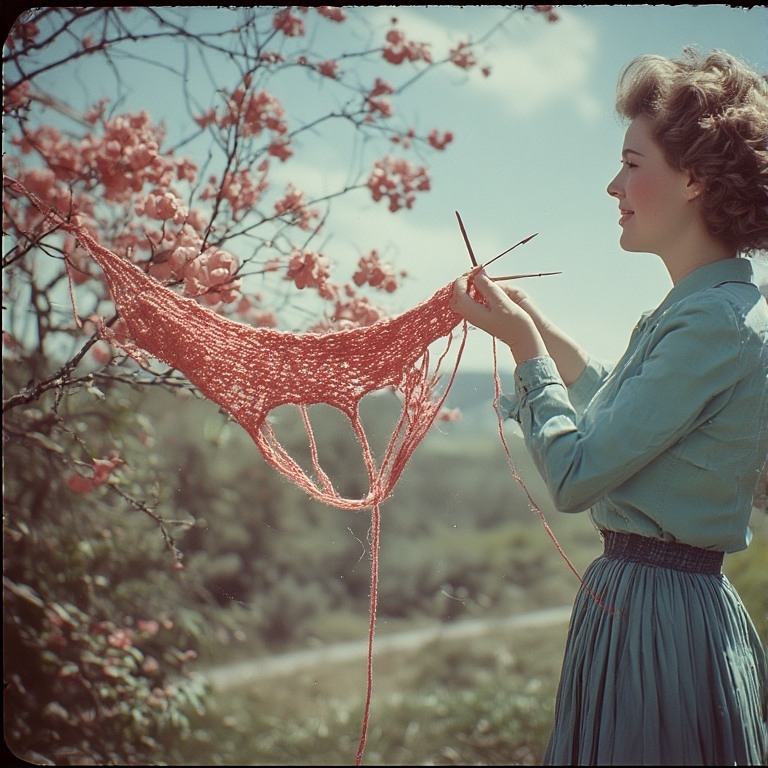
All of the images in this post were generated by an ai in response to the simple two-word prompt “lovely knitting”


Leave a Reply