The book is out, all pre-ordered copies have been shipped (thank you, Kate C and Kendall) and club members can access the full e-book in your Ravelry libraries. Knitting Wester Ross is now available to purchase in the KDD shop and by way of celebration, I thought I’d reproduce the book’s introduction here today. This is how this collaborative, multi-disciplinary project, which eventually became a book began . . .

A few years ago, Tom and I took ourselves to Wester Ross for a week’s walking. Travel restrictions had just been lifted, and it was so good to be out and about again, enjoying this particularly beautiful part of Scotland. We stopped in Gairloch to visit its small museum, recently relocated to a renovated cold war bunker, and spent a fantastic morning exploring its exhibits. I love local museums, and I realised pretty quickly that this was one of the best: a thoughtfully curated hub of cultural memory whose thematic spokes radiated out into the surrounding landscape. In the museum we learned about the mysterious Picts whose gigantic carved stone formed the museum’s iconic centrepiece, and we found out about Kay Matheson a local domestic science teacher who, in December 1950, had stolen Scotland’s fabled Stone of Destiny (wow!). Through the exhibition spaces we followed the human population’s shifting relationship with the sea and with the land; encountered the changes wrought by famine and by war, and discovered the traces left in the landscape by early peoples like the Bronze Age settlers whose excavated roundhouses could be explored on well-maintained hillside trails behind the museum.

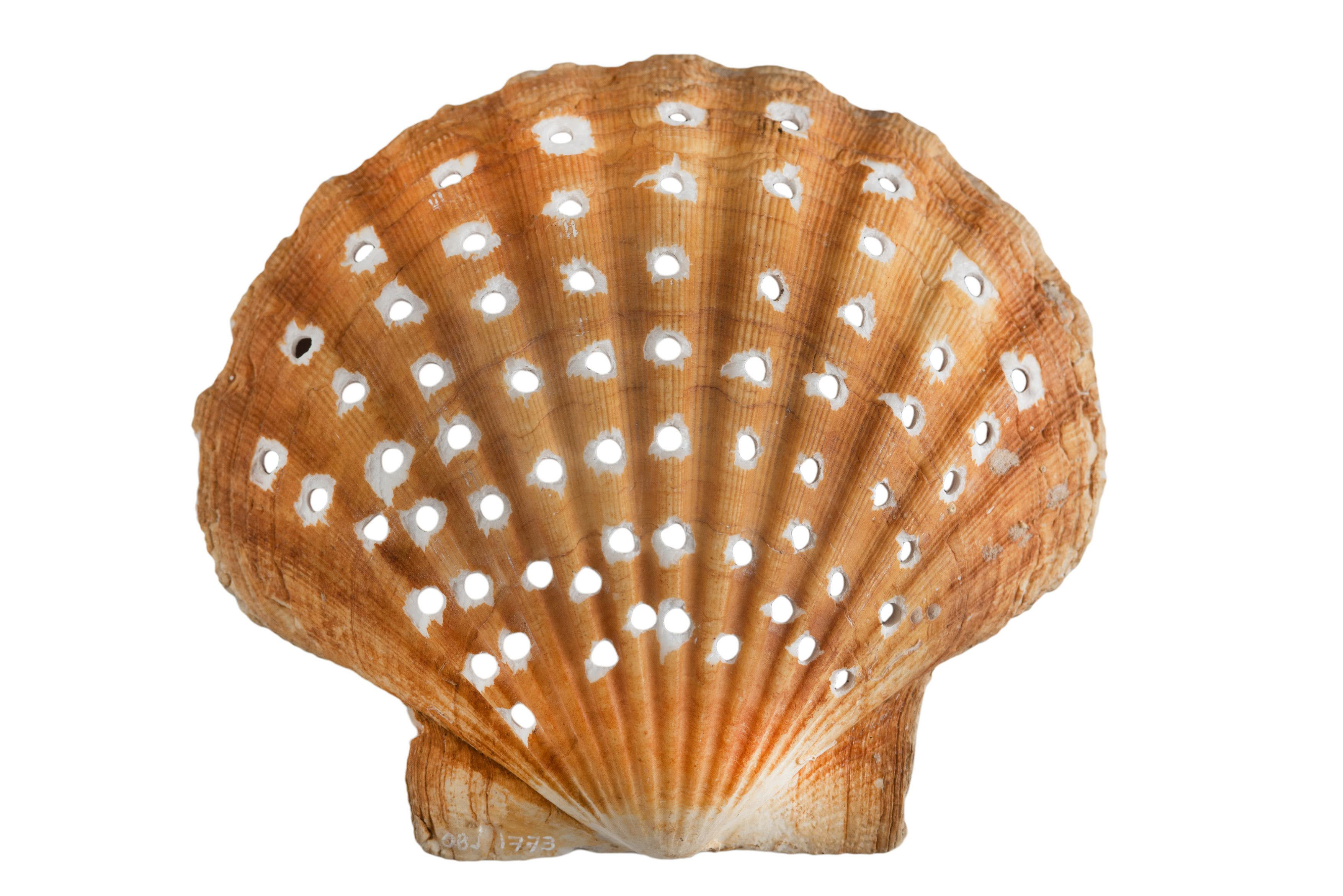
There were so many excellent galleries, each of which had been carefully designed to enrich the visitor’s understanding of the long story of Wester Ross, but among them there was one object that really captured my attention. Behind glass, and backlit, this thing shone out of its case like a numen in a reliquary. Bending down to read the curatorial note beside it, I discovered that this wondrous object was a milk creamer, formed from a scallop shell, and that it had been used by local women, who spent their summers tending cattle at the shieling, and making crowdie (a soft cheese).

Not since encountering Cy Twombly’s Fifty Days at Iliam at the Museum of Art in Philadelphia had I experienced the sort of reeling feeling you get when something calls you from across the room and insists that you meet it, where it is. Twombly’s art is epic and monumental: the Gairloch scallop creamer was the complete opposite of that, and yet it induced in me a similar range of powerful emotion. The size of a human palm, the shell’s radiating furrows seemed to address themselves directly to the extended fingers that once would have plucked it from the shore. A pair of working hands had then made it into a working object, boring neat holes at regular intervals along each of its raised ridges, creating a useful sieve to separate curds from whey. As a tool, the creamer was remarkably simple: a single human intervention had, with a few holes, transformed a thing of nature into a thing of human culture. And it was precisely this simplicity—the way that the shell’s original form and its new human function worked so perfectly together—that made it such a beautiful vernacular object. Sitting behind museum glass, the scallop creamer now addressed itself directly to contemporary visitors from all over the world, communicating so much about the way life had once been lived here, in this place, between the shieling and the sea. Without making a sound, the scallop shell spoke volumes about the history of rural life in Wester Ross.

In subsequent days, the shell continued to bother me, in the best kind of way that material things can bother you when they insist on sparking thought. I found myself lost in reflections on the forms and names of the old Scottish lace patterns; on the way that such patterns so often referred to scallops and to shells; and upon how Highland women had knitted and worn such shawls in living memory. Then, as I walked among the local hills which had once been shieling pastures, I thought about all of the ways in which these places had fostered different kinds of making, and how beautiful material objects—like a scallop-edged hand-knitted shawl or a simple creamer formed from a shell—could so powerfully enrich the rhythms of everyday life. A few days later, I phoned the museum, and spoke to the curator who had placed that shell in its glass case. She (of course) turned out to be a talented knitter and spinner and a larger idea began to form. What if the scallop shell, alongside other local objects and stories, became the basis for a collection of place and landscape-inspired knitting patterns? Might she be interested in helping me to develop such a project? I’m very happy to say that Karen Buchanan said yes, and that Knitting Wester Ross is the result.

With the invaluable help of Karen’s local knowledge and curatorial expertise—first at the Gairloch Museum, and later, the Arctic Convoy Museum—this project has slowly taken shape. Each of the patterns and essays in this book has been directly inspired by a Wester Ross place, object, or person, or in some instances, by all three of those things at once. Sometimes you’ll find the trajectories between objects and patterns, or essays and places, very direct and obvious, as is the case with the connections between the shell creamer, Karen’s essay about shieling life, and my Beinn Àirigh Charr shawl, whose ridges and furrows echo those of the object which inspired it, and whose interesting scalloped edging I hope you’ll find a more engaging knit than the familiar “auld shell”.

Sometimes a museum encounter has prompted me to learn much more about a subject as well as to develop a design: this was the case with the evocative pencil sketch produced by young able seaman, Denys Martin (which moved me very powerfully in the Arctic Convoy Museum); with the Gairloch pattern (of which you’ll find several beautiful examples in the Gairloch Museum) or with the life and work of Kay Matheson (whose archival collection of hand-knitted and crocheted garments I was able to explore one wonderful afternoon, with Karen).

Both Karen and I felt that there was no designer better equipped to take inspiration from the Pictish symbol stones of Wester Ross than brilliant Lucy Hague . . .

. . . while Jeremy Fenton generously agreed to share the story of the development of the Achtercairn Archaeology Trail. I find Jeremy’s work a highly inspiring example of how, with personal dedication and hearts open to discovery, each of us might enrich the public sphere.

Over the years that have unfolded between the beginning of this project and the publication of this book, Tom’s photographs have documented its development, revealed the glorious landscape of Wester Ross in every season, and depicted, Kate C, Karen and me wearing knitwear in all weathers (with occasional welcome help from Jim). Behind the scenes, meanwhile, Maylin, Claire and Debbie have been there, knitting alongside me, while Frauke and Ivor have kept us all in check with their editorial eagle eyes. What a privilege it has been to develop this project alongside a group of such talented friends. I’ve learned so many things from working on Knitting Wester Ross, most importantly, that when an object addresses you from inside a case in a museum, it’s a good idea to pay attention.

Knitting Wester Ross is now available from the KDD shop! Retailers: you’ll be able to order the book next week, when we’ll be sending out our new trade catalogue.


Leave a Reply