Warning: this missive contains more helle-boring content!

After learning about hellebores and their nectaries I was left wondering at what point, in the history of science, the crucial role these structures played in pollination had been understood. How had early botanists looked at hellebores? How had hellebores been represented in botanical art and illustration? Some happy hours, in which I explored these interesting questions through the digitised collections of various museums and libraries, ensued.


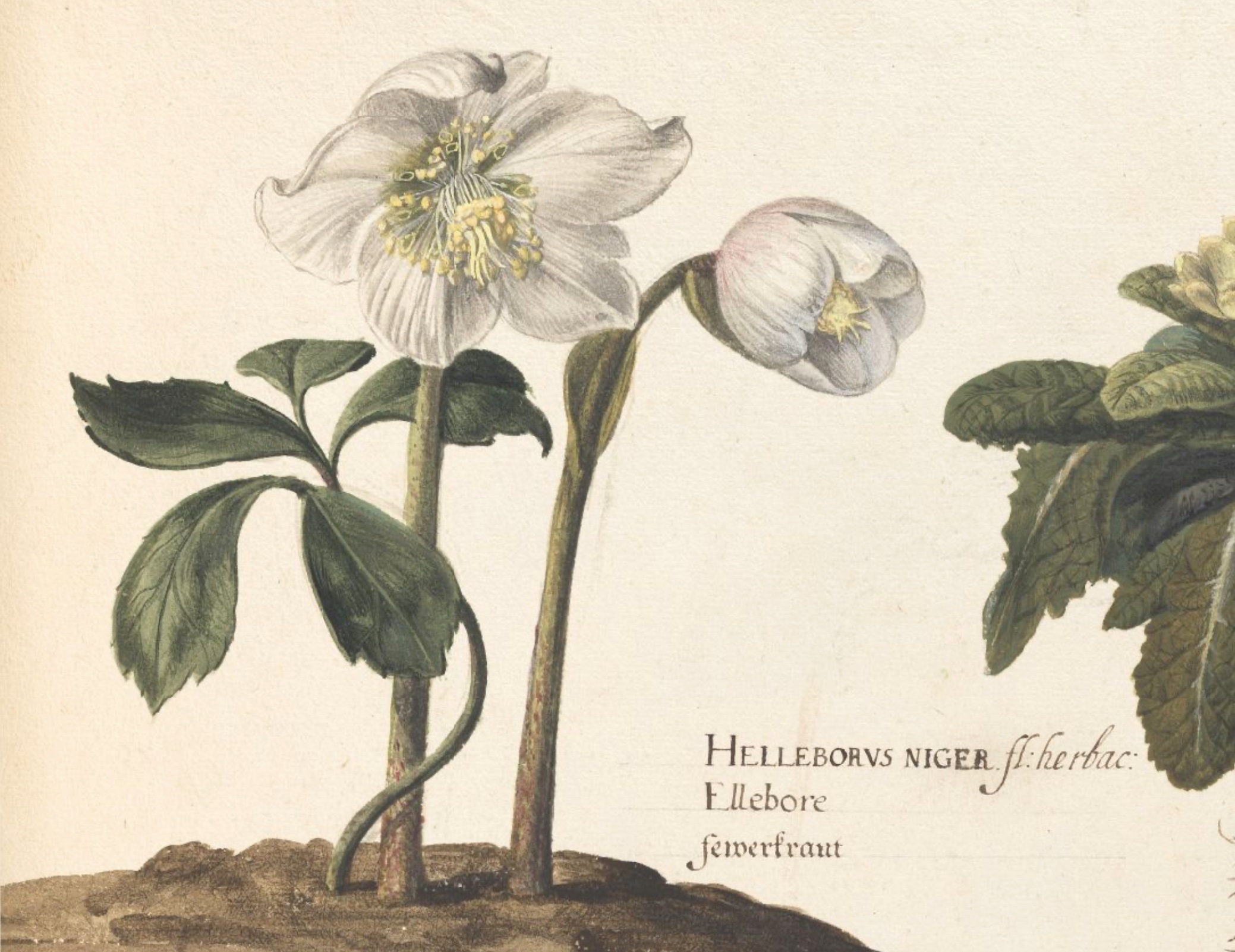
Because of the plant’s well-known toxic and emetic properties, Hellebores feature in several early illuminated “herbal” manuscripts, but appear without visible nectaries. The earliest illustrations I found in which nectaries were definitely identifiable were this etching, dated 1617 in the Rijksmuseum collections . . .

. . and the work of Pieter van Kouwenhoorn in the 1620s and 30s . . .

Across a wide range of seventeenth and eighteenth-century illustrations, the appearance (or non-appearance) of nectaries is very inconsistent. They are clearly depicted in the work of Georg Ehret, for example:

. . .but not that of Mary Delany . . .

. . . they are present in an early issue of Curtis’ Botanical Magazine

. . . but not in this eighteenth-century album of botanical watercolours.

Apart from the fact that a hellebore’s nectaries are only visible prior to fertilisation when its flower is in full bloom, one reason for this visual inconsistency is probably that the role and function of the nectaries was, at this time, not well understood.

While Linnaeus had described the sex lives of plants (in self-consciously anthropomorphic and erotic terms) in his Systema Naturae (1735) and Species Plantarum (1753), the crucial role that insects played in fertilisation was not understood until Christian Sprengel published his Das entdeckte Geheimniss der Natur (The Discovered Secrets of Nature in the Construction and Fertilisation of Flowers) in 1793.

In this beautiful book, illustrated with over a thousand figures, Sprengel showed how some flowers seemed to have been adapted specifically to enable particular insects to access their nectar and pollen. He also pointed out that the structure of some flowers meant that the process of fertilisation by their own pollen (which Linnaeus had described) was biologically impossible. Sprengel argued that these flowers produced nectar in order to attract insects, who assisted with pollination while stopping by for a tasty drink.

Sprengel’s innovative arguments about the instrumental roles of nectar and insects in plant pollination proved controversial, however. Ignored and dismissed by fellow scientists in his own time, it was not until Charles Darwin published his work on the Fertilisation of Orchids (1862) that Sprengel’s groundbreaking thesis was recognised as fact.

How did such knowledge alter the visual representation of the hellebore? The interesting answer is – not all that much. While nectaries certainly became a more prominent feature of later botanical illustrations, the Victorian fascination with the “language of flowers”, also meant that the Hellebore acquired a range of persuasive sentimental and religious associations as the “Christmas” or “Lenten” rose, and increasingly appeared in more decorative works . . .


. . . in which botanical accuracy was less of a priority.

Such stylised hellebores definitely have their own pleasures though!

I hope you’ve enjoyed this brief historical tour through the hellebore’s visual representation, which for me has opened up several avenues for further exploration.
In my next post I hope to have news of a completed book!


Leave a Reply