Warning: this missive contains more helle-boring content!

An illustrated manuscript page featuring various plants, each labeled with unique names in red and black lettering. The plants include detailed depictions of leaves, flowers, and stems in vibrant colors.
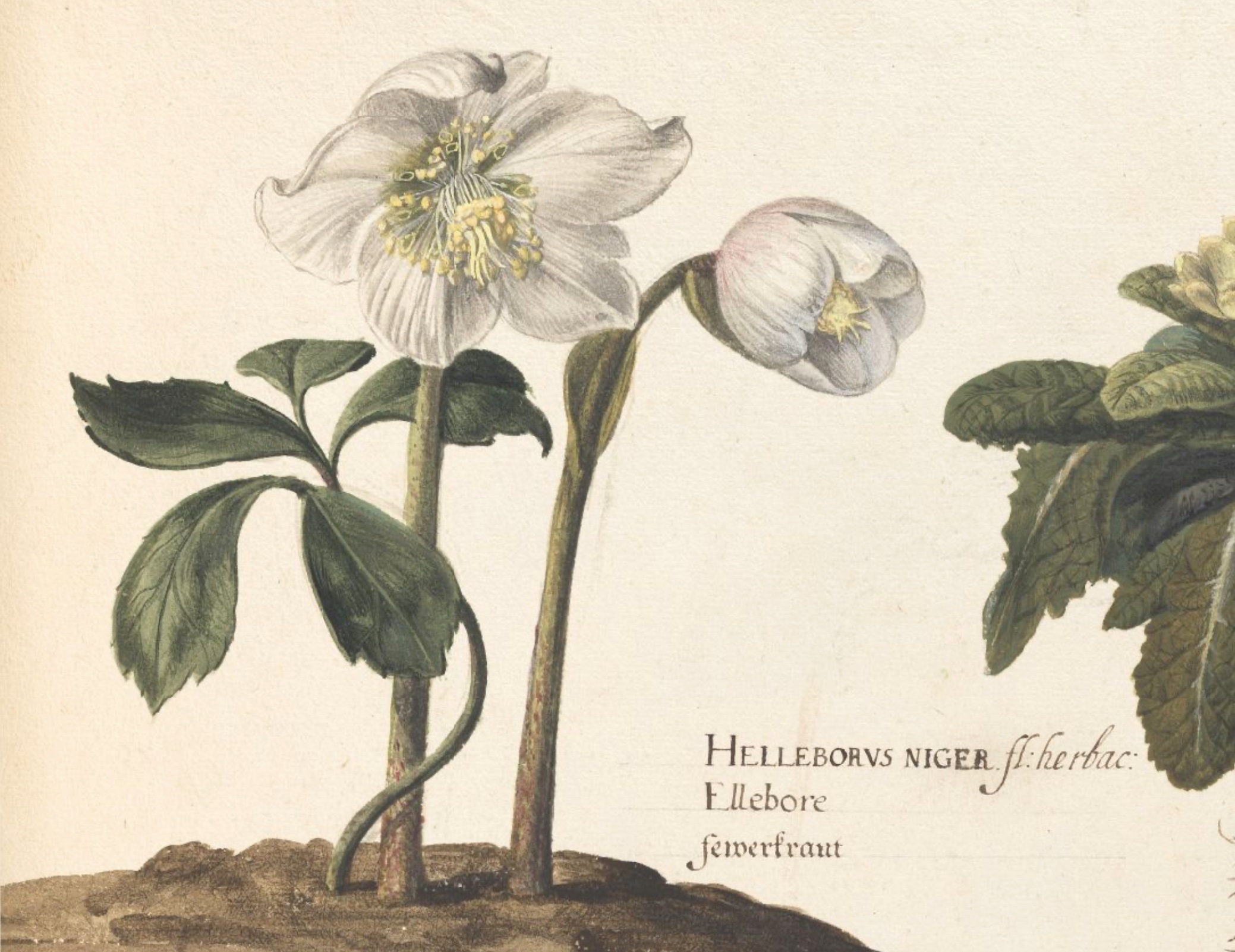
Ilustration of “Elebre” (Hellebore) in the Helmingham herbal and bestiary, Helmingham, Suffolk, circa 1500, Yale Center for British Art, Paul Mellon Collection.

After learning about hellebores and their nectaries I was left wondering at what point, in the history of science, the crucial role these structures played in pollination had been understood. How had early botanists looked at hellebores? How had hellebores been represented in botanical art and illustration? Some happy hours, in which I explored these interesting questions through the digitised collections of various museums and libraries, ensued.

Illustration of the plant Elloborus niger (Veratrum nigrum) with green leaves and yellow-green flowers, accompanied by a small striped caterpillar, on a plain background.
Anselmus Boëtius de Boodt, Elleborus Niger (Black Hellebore) c.1596-1610. Rijksmuseum.
An illustration of Helleborus niger with several flowers and leaves displayed, featuring delicate white and pink petals against a neutral background.
Anselmus Boëtius de Boodt, Elleborus Niger (Black Hellebore) c.1596-1610. Rijksmuseum.

Because of the plant’s well-known toxic and emetic properties, Hellebores feature in several early illuminated “herbal” manuscripts, but appear without visible nectaries. The earliest illustrations I found in which nectaries were definitely identifiable were this etching, dated 1617 in the Rijksmuseum collections . . .

An engraved illustration of a blooming flower with detailed leaves, surrounded by a natural landscape, shown on a page from a botanical book.
Crispijn van de Passe, 1617. Rijksmuseum

. . and the work of Pieter van Kouwenhoorn in the 1620s and 30s . . .

Illustration of Helleborus niger, featuring a flowering plant with white blooms and green leaves.
Pieter van Kouwenhoorn, Helleborus Niger (c. 1630). Royal Horticultural Society Collections.

Across a wide range of seventeenth and eighteenth-century illustrations, the appearance (or non-appearance) of nectaries is very inconsistent. They are clearly depicted in the work of Georg Ehret, for example:

An illustration featuring flowering hellebores with pale petals and green leaves, accompanied by a butterfly. The lower part shows a cluster of yellow flowers, with a label identifying the plant as Helleborus niger.
Georg Ehret, Helleborus Niger (1756). Victoria and Albert Museum

. . .but not that of Mary Delany . . .

An illustration of two white flowers with pale pink accents and green leaves on a black background.
Mary Delany, Helleborus Niger (paper cut), 1778. British Museum

. . . they are present in an early issue of Curtis’ Botanical Magazine

An illustration of the Black Hellebore plant, featuring a detailed image of the flower, leaves, and roots on the right page, with descriptive text about the plant on the left.
Curtis’ Botanical Magazine (1787)

. . . but not in this eighteenth-century album of botanical watercolours.

Illustration of a Helleborus niger plant, featuring dark green leaves and a single pale green flower with slightly pointed petals, displayed on a page of an artistic botanical book.
Anonymous, Helleborus Niger viridi, eighteenth-century album, Rijksmuseum.

Apart from the fact that a hellebore’s nectaries are only visible prior to fertilisation when its flower is in full bloom, one reason for this visual inconsistency is probably that the role and function of the nectaries was, at this time, not well understood.

Illustration of a Helleborus niger plant featuring white flowers and green leaves on a light background.
John White, Helleborus Niger (1600). British Museum.

While Linnaeus had described the sex lives of plants (in self-consciously anthropomorphic and erotic terms) in his Systema Naturae (1735) and Species Plantarum (1753), the crucial role that insects played in fertilisation was not understood until Christian Sprengel published his Das entdeckte Geheimniss der Natur (The Discovered Secrets of Nature in the Construction and Fertilisation of Flowers) in 1793.

Title page of the book 'Das entdeckte Geheimnis der Natur im Bau und in der Befruchtung der Blumen' by Christian Konrad Sprengel, featuring intricate illustrations of flowers and insects.
Title page of Christian Sprengel Das entdeckte Geheimniss der Natur (1793)

In this beautiful book, illustrated with over a thousand figures, Sprengel showed how some flowers seemed to have been adapted specifically to enable particular insects to access their nectar and pollen. He also pointed out that the structure of some flowers meant that the process of fertilisation by their own pollen (which Linnaeus had described) was biologically impossible. Sprengel argued that these flowers produced nectar in order to attract insects, who assisted with pollination while stopping by for a tasty drink.

Illustration of various flowers and their parts, including detailed depictions of petals, stamens, and a central flower with distinct characteristics.
illustration of insects drinking nectar and depositing pollen from Sprengel’s book

Sprengel’s innovative arguments about the instrumental roles of nectar and insects in plant pollination proved controversial, however. Ignored and dismissed by fellow scientists in his own time, it was not until Charles Darwin published his work on the Fertilisation of Orchids (1862) that Sprengel’s groundbreaking thesis was recognised as fact.

A detailed botanical illustration of a flowering plant with white and pink blossoms, green leaves, and roots visible beneath the soil.
Illustration of Helleborus Niger in Pierre J F Turpin ‘Fleurs’ album c. 1800. Royal Horticultural Society.

How did such knowledge alter the visual representation of the hellebore? The interesting answer is – not all that much. While nectaries certainly became a more prominent feature of later botanical illustrations, the Victorian fascination with the “language of flowers”, also meant that the Hellebore acquired a range of persuasive sentimental and religious associations as the “Christmas” or “Lenten” rose, and increasingly appeared in more decorative works . . .

. . . in which botanical accuracy was less of a priority.

A botanical illustration featuring various flowers, including green buds and leaves, on a textured paper background. The image contains delicate linework and watercolor details, with a caption indicating 'Heltboroke Green Walberwick 1915.'
Charles Rennie Mackintosh, green Hellebore (1915). Victoria and Albert Museum.

Such stylised hellebores definitely have their own pleasures though!

A black and white floral linocut print featuring various stylized flowers and leaves, with intricate detailing and textures.
Maria Luiza Amaral, woodcut print of Hellebore (1935), Victoria and Albert Museum.

I hope you’ve enjoyed this brief historical tour through the hellebore’s visual representation, which for me has opened up several avenues for further exploration.

In my next post I hope to have news of a completed book!


Discover more from Kate Davies

Subscribe to get the latest posts sent to your email.


Comments

30 responses to “helle-bore-us”

  1. Cynthia L Avatar
    Cynthia L

    Great stuff. Good research :)

  2. Thank you, I love such dives to find an answer to something, both when I do them myself and when I read about someone else’s!

  3. Fascinating as always, Kate! 😍 I so enjoy reading your posts; thank you. Now that I see & understand their tiny details, & know a little of their botanical history, I love my hellebores even more.

  4. Kylie Buday Avatar
    Kylie Buday

    I love the hellebore lore. I have many varieties in my yard and just adore them. I live on Vancouver Island and the Pacific Northwest climate loves hellebores. My obsession started after I bought A Tapestry Garden by Marietta and Ernie O’Byrne, which devotes a full chapter to hellebores. The O’Byrnes bred a variety they aptly named Winter Jewels. My kids have forbidden me from buying more and would definitely call me a hella-bore.

  5. Valerie Avatar

    Wow! Who knew this was such a very old plant! I enjoyed all this info. Deep dives take work and time for sure. Thank you for putting this all together!

  6. SL Brown Photo Avatar
    SL Brown Photo

    These are among my favorite flowers but they do not grow here

  7. You are a helle of a writer, always delightful and fascinating – a treat to read

  8. Juliet Thomson Avatar
    Juliet Thomson

    Loved it thank you

  9. Linda Foulds Avatar
    Linda Foulds

    What a gorgeous line up of helebore illustrations. On this -16C day in western Canada it was a taste of Springtime! Thankyou so much for sharing your wonderful research.
    Cheers
    Linda

  10. Rhona Arthur Avatar
    Rhona Arthur

    I’m a huge fan of hellebores and luckily my garden soil likes them too. It was so interesting to read your article and look at the drawings.
    Good to have you back and look forward to news of the book.

  11. Margaret Hudson Avatar
    Margaret Hudson

    Thank you, that was very interesting! I\’m a botanist and appreciate both the flowering plants and the designs they inspire. Margaret Hudson

  12. susan McKee-Nugent Avatar
    susan McKee-Nugent

    Dear Kate, Such an eye opener and Not Boring!! Thank you for all the research.

  13. Corynne Avatar

    Our ancestors used to float the flowers in a wide bowl of water in order to display their beauty indoors.

  14. Cristina Sanvido Avatar
    Cristina Sanvido

    Per il libro possiamo aspettare….l’importante è che tu stia meglio!
    Cristina

  15. Melaura Duncan Avatar
    Melaura Duncan

    thank you for sharing the botanical illustrations – I love finding them and hate that some individuals took books apart to sell them individually. Cheers!

  16. Karen Grandidier Avatar
    Karen Grandidier

    I saved both of your Hellebores posts to share with my non-knitting, gardening friends. They will share the same delight as I have. Thank you for this informative and interesting research on this amazing flower.

  17. Eli Wongraven Avatar
    Eli Wongraven

    Thank you for this lovely and informative post! I was first made aware of hellebores by my nearest and dearest, and we had fond memories of seeing them all over London when visiting before many Christmases. Now he’s departed I still buy them before every Christmas as a loving memory of our trips.

  18. Mary Miller Avatar
    Mary Miller

    Helle-bore-us-not. With the wonderful visuals (thank you, Tom) and text these emails have been delightful.

  19. Well done article on hellebores! I have a very shady on the forests edge garden and have been looking for inspiration to plant this year. Hellebores will fit the bill I think! Very interesting article. And so glad to see that you are back to writing and creating again. Thank you so much!

  20. Sylviane van Vyve Avatar
    Sylviane van Vyve

    What interesting research I love hellebores and you’ve taught me so much Thank you Kate for this lovely article Sylviane

  21. So beautiful! I love your attention to detail and how you bring that to us, inspiring us to “look closer” at the beauty that surrounds us every day! Cant be reminded of this too often! Thank you❤️

  22. Mary Ashton Avatar
    Mary Ashton

    Thank you Kate for another informative post. I always love the illustrations you find to intersperse amongst your thoughts. Today’s do not fail to delight. You have such a wonderful talent that you share with us all.

  23. I love the botanical drawings of Charles Rennie Mackintosh. So spare and so modern.

  24. Wow, I learned so much. You are absolutely amazing. Hope you send more stories.
    Your writings have been the highlights of this depressing winter. Thank you!
    🤗❤️Lis

  25. Antonella Avatar
    Antonella

    So beautiful and fascinating mail I found today! Thank you 🙏

  26. Susan bandel Avatar
    Susan bandel

    Love your epistle on hello bores. Beautiful flowers. Hope your weather is warming up.

  27. Hoping this post means you are better. Nice botanical review!

  28. owllette17 Avatar
    owllette17

    Dear Kate. I have not yet bought anything from your site, as because I live in France, I have to take into account the rate of exchange! But I love all the models.I joined the Wester Ross club; and I found all the articles so interesting . I love Hellebores, often known as Christmas roses. Once again you have shared another article ; beautiful and very informative. Thank you. Best regards. Avril stambach.

  29. Lynn McCallum Avatar
    Lynn McCallum

    My fav is the Macintosh illustration. I love this exploration!! I hope you have a warmish spring day. My hellebores and snowdrops are under more snow.
    Thanks for this even deeper dive.

  30. Fascinating. I am ashamed to confess I have neglected my Hellebores. I will waders out through what’s left of the snow and tidy them up. Who knew they only needed a little leaf pruning?

Leave a Reply to Sylviane van Vyve Cancel reply

Your email address will not be published. Required fields are marked *