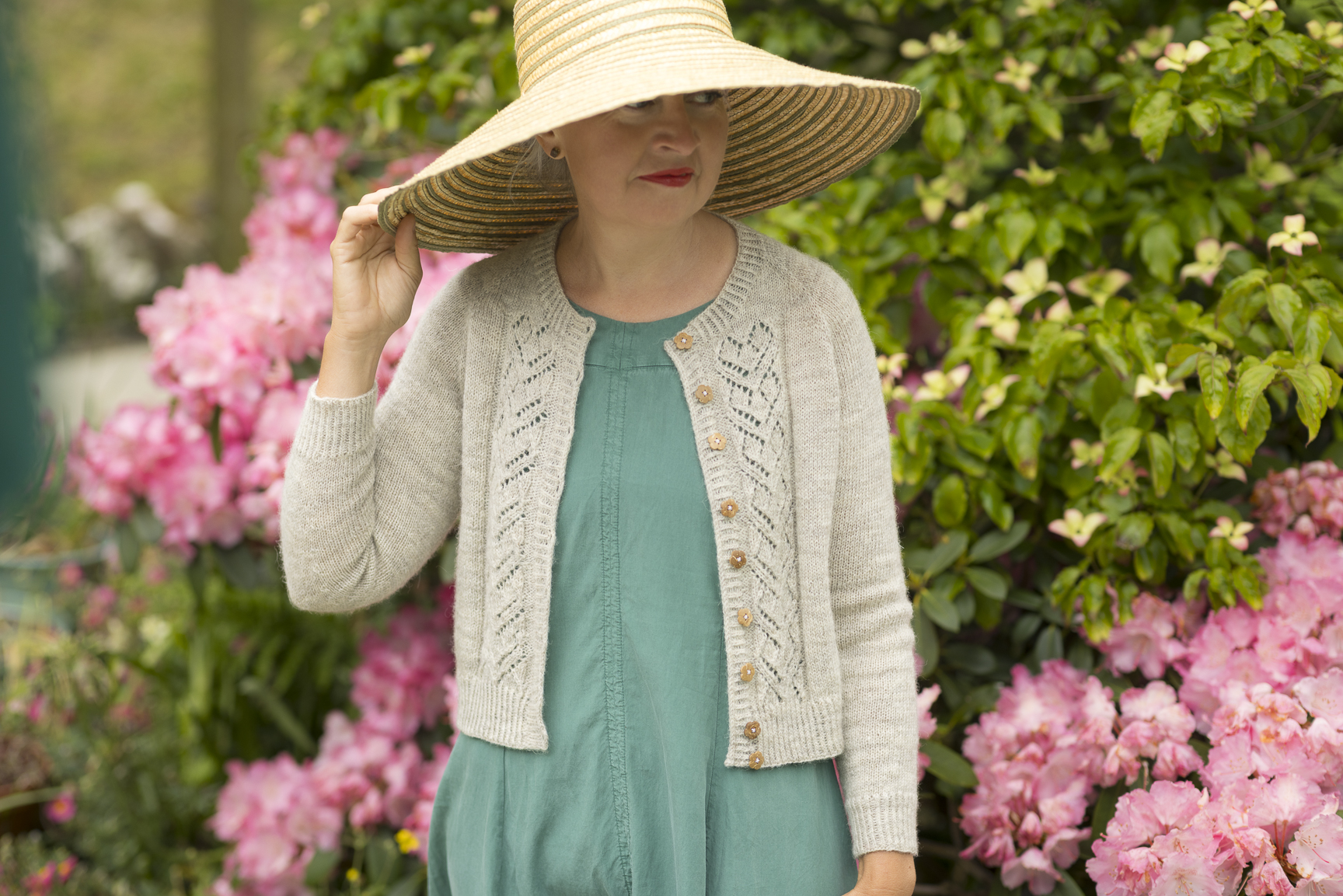

Good morning, and welcome back to the mill garden! Here I am to show you another Yorlin, which has been knitted in a rather different yarn to the Milarrochy Tweed Ardlui version I was wearing yesterday.

This cardigan has been knitted in our Ooskit 4 ply.

The yarn’s name is Ooskit “4 ply” to distinguish it from our Ooskit (DK, or double knitting) weight . . .

. . . and we now enter that somewhat confusing realm of yarn nomenclature, where “4 ply” is a term that refers specifically to the weight and yardage of the yarn rather than to the actual number of plies, or strands, of which the yarn is composed (please bear with me) . . .

While Milarrochy Tweed is a “single”, in which wool, mohair, and tweedy neps are spun into one strand that knits up at a standard 4 ply weight, Ooskit 4 ply is made up of two strands of yarn that have been twisted together to knit to a similar weight and gauge.

Both of these yarns are somewhat anomalously referred to as a “4ply”, then, and the yardage of Milarrochy Tweed and Ooskit is similar, but not exactly the same: MT gives roughly 100 metres to 25g, and Ooskit slightly more, 110 metres. This 10 metre disparity is accounted for by the two yarns’ different spinning process, as well as their differences of composition. While MT contains 30% mohair and 70% wool and is spun using the woollen process into a nubbly yarn whose uneven nature is an intentional characteristic, Ooskit 4 ply is a worsted-spun blend of two very specific fleeces: Bluefaced Leicester (a sheep whose fleece is notoriously fine and silky-soft) and Masham (a dark fleece, small quantities of which are blended in to create Ooskit’s rather satisfying silvery-grey colour). These two fleeces, together with the worsted spinning process, combine to create a yarn of really exceptional smoothness, whose evenly-spun nature means that each skein gives slightly more yardage to the gram than the characteristically thick and thin MT.

Ooskit 4 ply and Milarrochy Tweed are two rather different “4 ply” yarns, then, but they also play very nicely together, as I’ve shown in some of my recent designs:


You can easily combine these two different yarns into lace or stranded colourwork, and you can also happily substitute one for the other in a single-shade project, depending on your knitting preferences. And if you are someone who likes working with – as well as wearing – a yarn that’s rather sheepy, while being surprisingly silky-soft, then you might really enjoy the process of knitting yourself an Ooskit 4 ply Yorlin, and be delighted with the end result.

The gorgeous sample I am wearing here was knitted by Debbie, who really has done a lovely job (thank you, Debbie!)

This close-up photograph shows the Yorlin lace very nicely, as well as giving you a good sense of the distinctive character of Ooskit’s finished fabric: sheepy, smooth, and super-soft.

This Yorlin feels light, airy and really comfortable to wear, even on a very warm day, like those we have recently been experiencing.

Yesterday I mentioned the issue of where to start the rib and end the lace when finishing off the body. Debbie has knitted the same size as my Ardlui version (the second), and you can clearly see in these photographs that the cardigan is exactly the same length as my Ardlui sample, sitting at high hip.

You can also see that the bottom rib is deeper: Debbie has knitted the number of rib rows the pattern specifies, while I knitted rather less. There’s consequently a little less lace in this sample, just over 7 repeats, while the Ardlui sample has 8. And as I mentioned yesterday, some chart rows work better than others when transitioning to the rib . . .

When you get to this point in the pattern, you’ll see that I specify ending the lace repeat on a row 1, 5, 9 or 15. These are all odd (RS) rows, and it’s important you end on a right side row, because you need that final WS row to make a necessary adjustment to the stitch count that will make the number of stitches for the rib work out. Those four rows are specified because they align so neatly and nicely with what follows: the knit stitches of the lace panel flowing seamlessly into the knits of the rib, and the purls lining up with purls.

I know that these four specific rows will produce this pleasing result because of all the work that Mel and I did, a few years ago, when I was developing this pattern.

Yes, we swatched the rib transitions from every row of the chart so that you don’t have to!

So just be sure, when you arrive at that point, to finish your lace knitting on one of the four rows specified in the pattern before working the ribbed hem, and you’ll achieve that lovely rib-transition flow which I (like many knitters, surely?) regard as one of the distinctive signatures of a really well-finished garment.

Before I go, there’s just time to show you my favourite part of the garden.

I like to sit and knit in a seat that’s positioned just to the right of where I am standing here, and it is, I think, my favourite knitting spot of all-time. Here, larks and blackcaps sing above me, while the Connieglen Water flows merrily down below. The wall behind me is part of a bridge, whose arch lends hilarious amplification to the doo-doo-ing collared doves and squabbling duckling nurseries who often pass beneath it. Just a little upstream, there’s an otter holt, and a mile downstream there is the sea. Despite the coastal proximity, this is a warm and sheltered spot: south-facing, wind-protected and full of all kinds of flourishing plants. Here you can see my alliums and foxgloves, and the salvia “wine and roses” just coming into bloom. Soon, verbascum will join the party of blooming spires, while sweet peas will scramble all the way up that back wall into the huge climbing rose above. I’ve planted several new shrub roses all around my knitting spot, and I’m looking forward to enjoying the scent and sight of them as the summer unfolds.

We have now added Ooskit 4 ply kits in all sizes to the shop, and here’s some useful information for you, if you have the Yorlin pattern already and would prefer to purchase single skeins. Remember that the put-up of Ooskit 4 ply is 50g, rather than the 25g of Milarrochy Tweed, and that the number of skeins required is consequently half as many. So while you’ll need 10 (10, 11, 12, 13, 14, 14, 15, 16, 17, 17, 18) x 25g balls of MT to knit yourself a Yorlin you’ll only need 5 (5, 6, 6, 7, 7, 7, 8, 8, 9, 9, 9) s 50g skeins of Ooskit. Additionally, please bear in mind that if you wish to add more than an inch of length to either the body and / or the sleeves over and above what the pattern specifies, that you may need an extra skein of yarn.
Happy knitting, and enjoy your Sunday!


Leave a Reply