The clocks have gone forward and we have made it through the winter (feeble yay). All over rural Scotland, this seasonal transition is marked by the movement of cattle to summer pastures, a tradition which is inscribed in the landscape with the old names of many fields and hills. Ten minutes walk from my front door, for example, is a Cnoc Àirigh to which livestock are still moved in summer months, albeit without the women and children who once would have accompanied them to the àirigh (shieling).

The work of women at the summer shielings of Wester Ross is the subject of a lovely essay by Karen in our (now forthcoming!) book. There were many seasonal jobs to do, among the most summery of which was making crowdie: a soft cheese produced from the creamy milk of cows fed on the rich, green pastures of July and August. To make crowdie, you need to separate curds from whey, and to do that you need a creamer:

You’ll find this marvelous crowdie creamer, formed from a scallop shell, on display in the Gairloch Museum.

As I explain in the book’s introduction (which you’ll be able to read soon), the whole Wester Ross project began with my encounter with this beautiful, simple object. For me, this shell became a kind of numen, speaking powerfully about the work of Scottish Highland women, and the material textures of their everyday lives.

Knitting was part of this everyday materiality too, of course, and I think it is very telling that so many of the old Scottish hap patterns are associated with shells. There’s the familiar “auld shell”, for example (the “shale” that often appears in stitch dictionaries being simply the result of an Anglicised phonetic transcription of a Scottish voice saying “shell”). I’ve a great fondness for these old patterns, in all their many rhythmic variants, and I particularly love the “cockleshell”: a centuries-old Shetland favourite, which I’ve featured in patterns like my Betty Mouat Cowl.

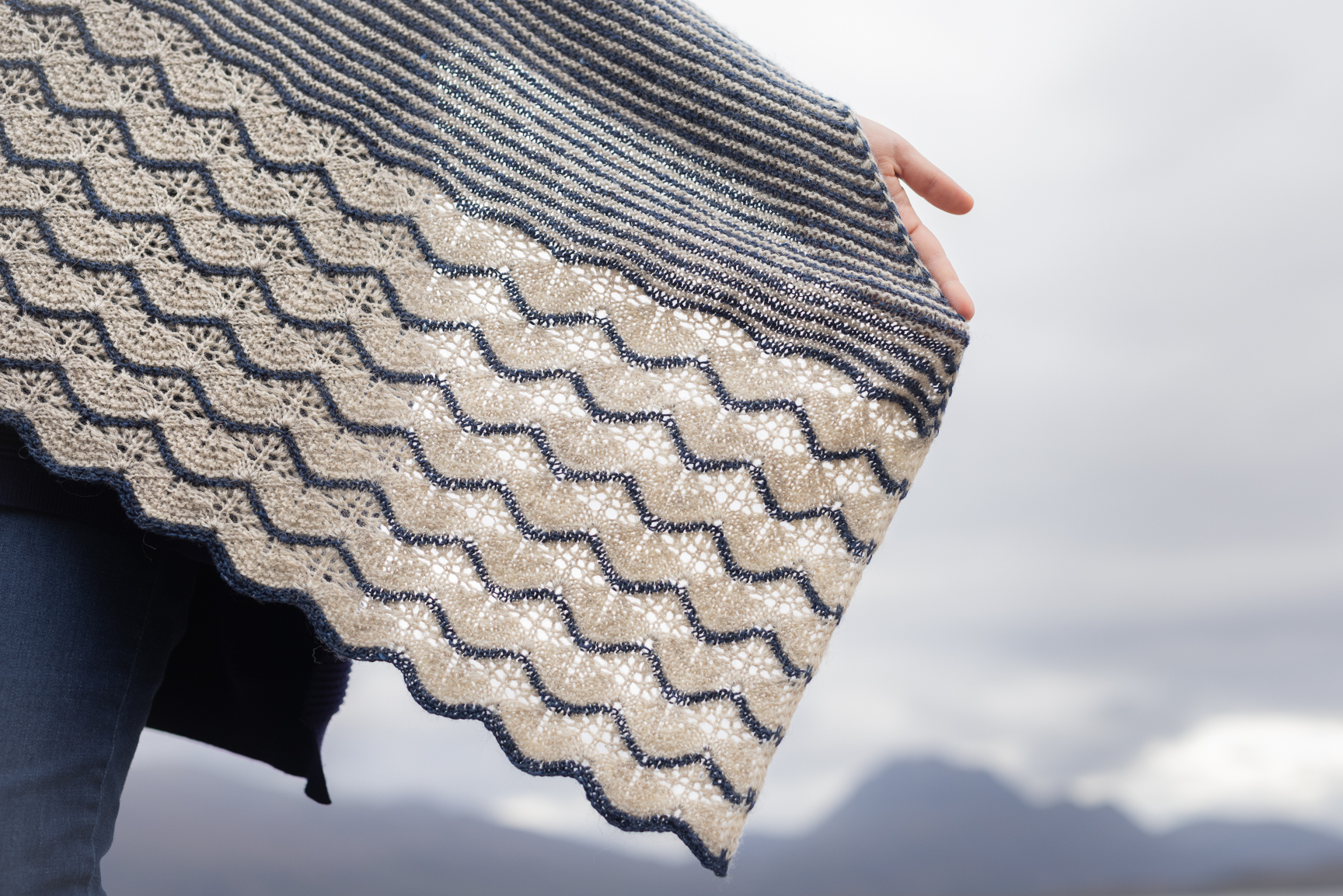
Inspired by the numinous creamer, I wanted to create a simple hap, of the type which might be made and worn at the summer àirigh, and which was immediately shell-suggestive. Scallop-like shapes in lace can be created by rapidly increasing and decreasing several stitches and in the Betty Mouat pattern, such shapes result from the elongation of fifteen adjacent stitches which are subsequently all knitted together on one row. Those of you who might find a k15tog instruction offputting will doubtless be pleased to learn that the lace scallops which I’ve developed for the Beinn Àirigh Charr pattern are much more straightforward. Five stitches are formed from one by knitting into the front and back of the same stitch: no dropped yarnovers here!

Scallop-y shapes reveal themselves in a sequence of undulating garter ridges . . .

. . . while the outermost edge of each “shell” is further highlighted by two rows knitted in a contrasting shade.

After the lace edging, the hap gradually tapers to a point by decreasing on one side only.

The tapering long triangle is a shape of which I’m very fond, and which I personally find much more wearable than more equilateral shawls. I’ve used this shape in a couple of other designs, such as Electric Village from our West Highland Way book.

I remember thinking I’d rather overdone it with the size of Electric Village, which really turned out to be gigantic . . .

So I reined in the dimensions somewhat for Beinn Àirigh Charr, whose size is still fairly generous . . .

. . .and cosily wrap-able. . .

. . . but not unmanageably mahoosive.

If you wanted your Beinn Àirigh Charr to be larger (or smaller), this is easily accomplished by adding more (or fewer) repeats at the beginning of the pattern, or alternatively adjusting the decrease rate along the shawl’s long sloping edge.

With shawls of this simple hap type, a nice finish can, I think, really elevate the design.

Here, slipped stitches worked along each long side create a braided cord effect . . .

. . . which is one of my favourite techniques to combine with garter stitch for a beautifully neat, clean edge.

You’ll notice that I’ve used the same Lochan / Ooskit yarn pairing in Beinn Àirigh Charr as I did for the Òran Eile and Brèid designs: this is not only because the combination of deep dark, moody blue and a pale silvery grey is one of favourite combinations (which it definitely is) but also because it is nice to create a sense of chromatic / thematic consistency across the designs in a collection.

If you’d like to knit Beinn Àirigh Charr (or any other design) in a different colourway to the one pictured, please do feel free to get in touch with Maylin (help@katedaviesdesigns.com) who can put your preferred palette together (adding the usual kit discount, which makes things cheaper than purchasing individual skeins)

Finally, how do you say Beinn Àrigh Charr? The Beinn part sounds much more like bayn, and I pronounce Àirigh Charr in much the same way as I do Arrochar, the Argyll village at the head of Loch Long, whose Anglicised name is surely shieling derived. For all of your Gaelic pronunciation needs, I’d heartily recommend the brilliant dictionary at Learn Gaelic where words and phrases are accompanied with good, clear audio clips from a contemporary Gaelic speaker.

I’ve been helped by several knitters when developing the designs for the Wester Ross collection. Maylin, Claire, Karen and Kate C you all know about, but I may not yet have mentioned Debra Muir, who was my brilliant test knitter for the Beinn Àirigh Charr design. Thank you, Debbie!
The Beinn Àirigh Charr pattern is now available on Ravelry, and there are kits in the shop too.
Enjoy your Sunday!


Leave a Reply