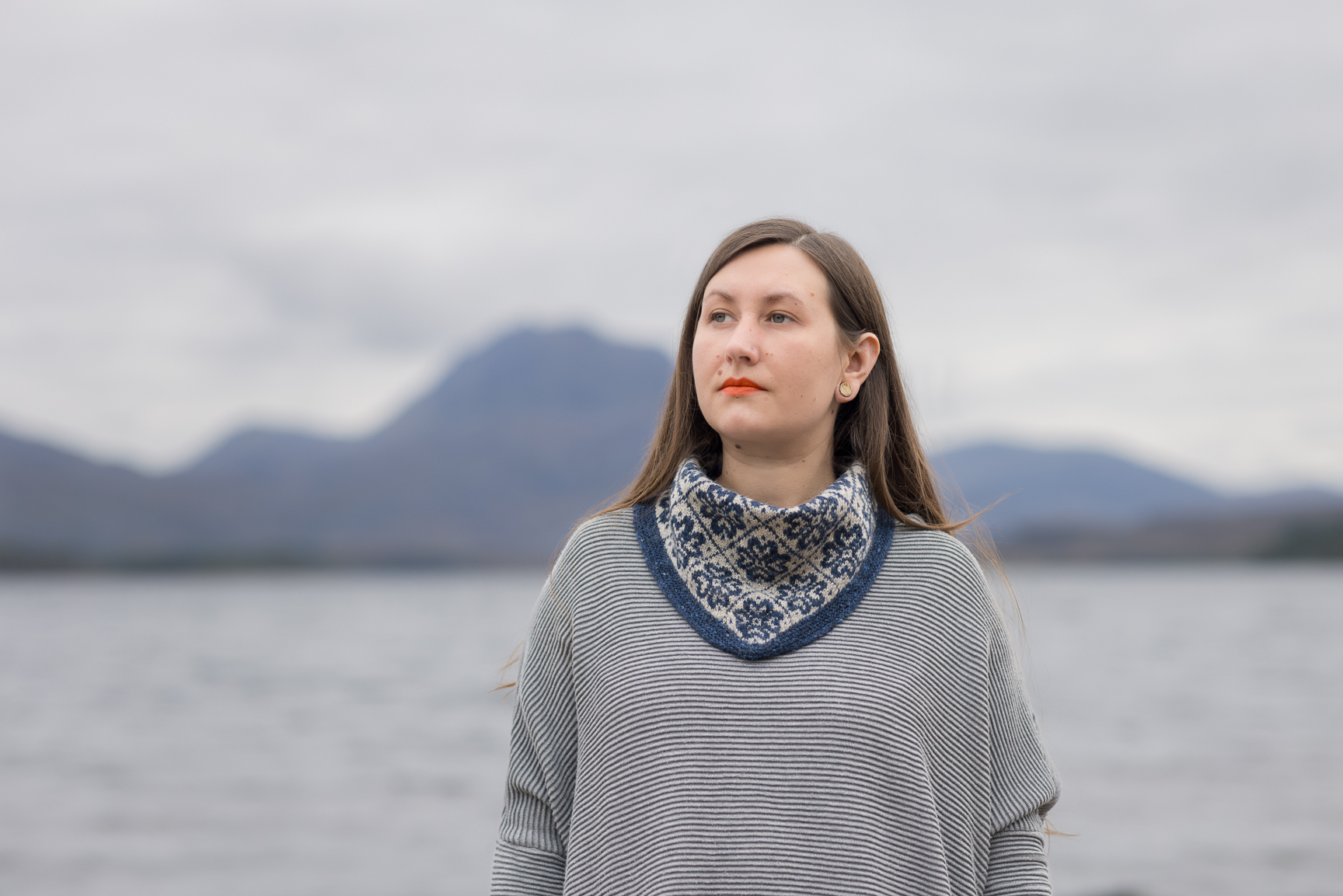
Following on from yesterday’s missive about my Òran Eile / Another Song design, here’s a pattern closely related to it: Brèid:

Brèid (pronounced like beige, with a rolled ‘r’ in it) is a Scottish Gaelic word for a kerchief. In Gaelic, brèid is a term applied to many different kinds of cloth or flappy things (including the very evocative name of the hen harrier, brèid-air-tòin) but which also has very specific associations with marriage, or married women. Some of you may be familiar with this lovely Gaelic blessing, a feature of many Scottish wedding ceremonies:
Mìle fàilte dhuit le d’bhréid, fad do ré gun robh thu slàn. Móran làithean dhuit is sìth, le d’mhaitheas is le d’nì bhi fàs.
A thousand welcomes to you with your marriage kerchief. May you be healthy all your days. May you be blessed with long life and peace. May you grow old with goodness and riches.
Marriage kerchiefs – traditionally formed from a square piece of cloth folded in two to form a triangle – would be symbolically placed on a bride’s head on the morning of her wedding, and worn afterwards as the sign of her status as a married woman – a brèideach.

Yesterday I described how I developed my vest design, taking inspiration from the raw meditation on lost love which is William Ross’ Òran Eile. Ross’ beloved had left him to marry a ship’s captain from Liverpool, and the poem describes her departure thus: do thuras thar chuan fo bhrèid with the lenited brèid here resonating both as “under sail” and “under kerchief.” A signature of the poet’s literal and symbolic loss, Ross’ doubly-chiming brèid also captures the artistry of an exquisite poem in which every word has been carefully honed and chosen.

Featuring the same palette and motifs as the Òran Eile design, my Brèid can be worn like a traditional kerchief . . .

. . .but also doubles as a cowl or bandanna.

I spoke yesterday of the challenges of working increases or decreases in colourwork: in Brèid, I’ve removed that problem for you by charting out the whole design.

Knitting this wee kerchief is a complete breeze, therefore: just follow the chart until you are done.

Brèid is knitted in the round with a steek: if you are a first-time steeker and would like to try this technique, but feel nervous about the idea of cutting up your knitting (st-eek!), Brèid is an ideal small project upon which to test your skills.

I felted the steek on this sample (check out Gretchen Funk’s brilliant tutorial for MDK) which is knitted in the same combination of Ooskit 4 ply and Milarrochy Tweed as the Òran Eile vest. Though spun differently, both of these yarns are composed of 100% natural fibres, and therefore felt well. Superwash yarns, or yarns containing nylon or acrylic, may felt less well, and are generally less suitable for steeking. First-time steekers: do bear this in mind!

Felting the steek, and cutting it with a very sharp pair of scissors results in a selvedge with a fabulously smooth, neat edge. Sometimes it’s nice to use a ribboned facing on a steek (along a cardigan’s front opening, for example) but I felt that there was no need to bother with a facing here. If you zoom in on the photo above, you’ll get a wee glimpse of my striped steek selvedge, which I’ve carefully stitched down to the wrong side of the fabric.

Brèid is a really versatile small accessory which can be worn in several ways (as capably demonstrated here by Kate C). The pattern includes finishing instructions for i-cord ties, but you could easily add a buttonhole and button into the kerchief edging, if preferred.

So that’s my Brèid: a wee kerchief or cowl inspired by the poetry of William Ross. . .

. . .but which carries no marital status assumptions of any kind: you definitely don’t have to be a brèideach to knit or wear this brèid!

The Brèid pattern is now available on Ravelry, and there are kits in the KDD shop.


Leave a Reply to N S Cancel reply