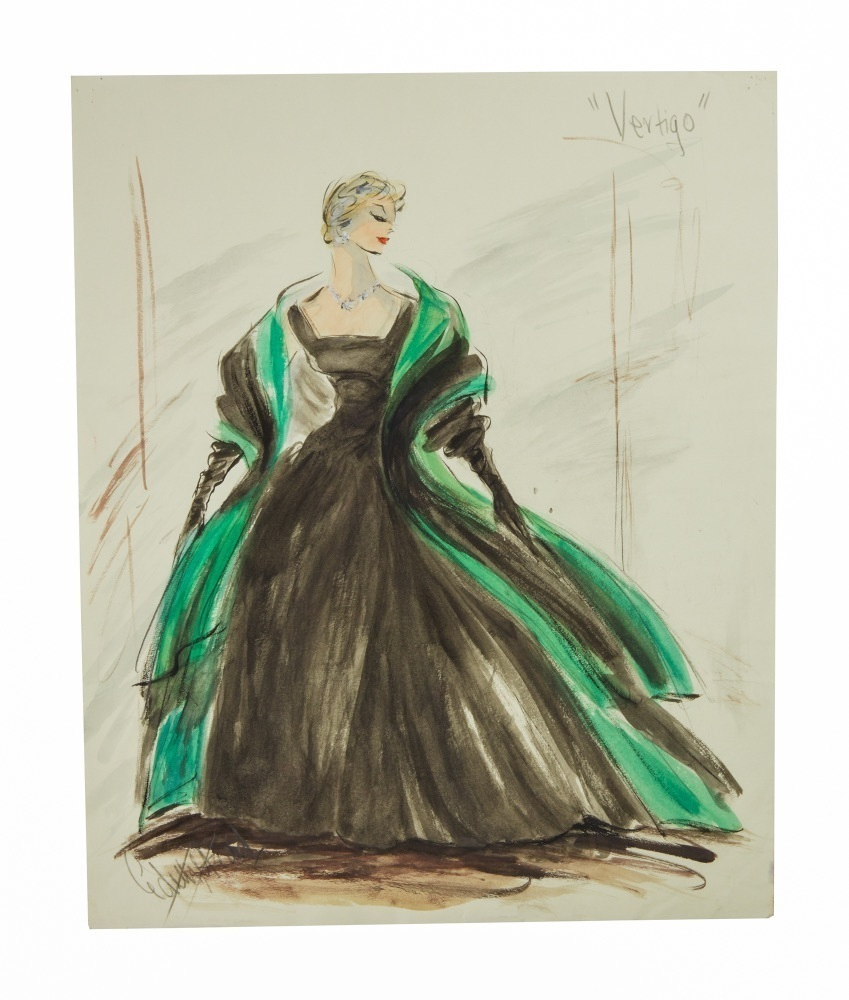

After watching Mark Cousins’ recent documentary, My Name is Alfred Hitchcock, Tom and I went on a bit of a Hitchcock binge, watching 20 Hitch films in succession (we lost momentum, and indeed the will to live, after Under Capricorn). Since the last time I’d watched Vertigo, I have become a bit obsessed with technologies of colour generally, and with those of technicolor in particular . . . but even so, I could not believe that I’d written a whole post about memorable on-screen green dresses while forgetting the dramatic outfit that Madeleine wears in the film’s first scene in Ernie’s restaurant:

Madeleine’s emerald green stole does an awful lot of work in this scene, popping out against the neutral colours of the evening clothes worn by the other diners, as well as providing a startling complementary contrast to the restaurant’s deep red walls. The woman whose physiognomy, elegant appearance, and melancholy charisma so captivate Scottie / James Stewart, is, of course, merely playing a role and in this scene, the shimmering green stole seems to be there to offer him (and the viewer) a visual clue to the performative and inauthentic nature of what we are seeing. It also suggests what is to come later in the narrative, when Judy – the “real” woman in a green dress – is revealed.

Once I noticed the symbolic use of green in the restaurant scene, I couldn’t stop seeing it. It’s everywhere!

From the paintwork of the Mark 8 Jaguar that Madeleine drives . . .

To the palette of the objects that surround her as Scottie stalks her through the streets of San Francisco.

Madeleine is always clad in neutrals as crisp and sophisticated as her platinum coiffe.

In the terms established by the film, these monochrome outfits – particularly the iconic grey suit – are meant to suggest Madeleine’s poise and unattainability. Green, on the other hand, is represented as something unruly and even vulgar lurking at the narrative’s margins. For green is the colour of the ordinariness (and availability) of the “real” woman who inhabits Madeleine’s icy façade.

Judy Barton is not only continuously dressed in green . . .

. . . but lit with it

And when she finally re-emerges, transformed, unwillingly, into Madeleine once more, her iconic grey suit, illuminated by the street’s green glow, assumes a sickly and a spectral hue. . . .

. . . that is also the colour of Scottie’s damaged and disordered psyche.

The plot of Vertigo is utterly preposterous, and it’s a film whose very narrative inconsistencies seem to leave a door open for many different kinds of symbolic reading, of which those involving colour are quite rewarding! If you’d like to explore the chromatic structure of the film in much more depth, I can highly recommend the chapter in Riccardo Falcinelli’s Chromorama, (which has been recently translated into English), and which is playfully illustrated by Livia Massaccesi


Leave a Reply to Anena’s World Cancel reply