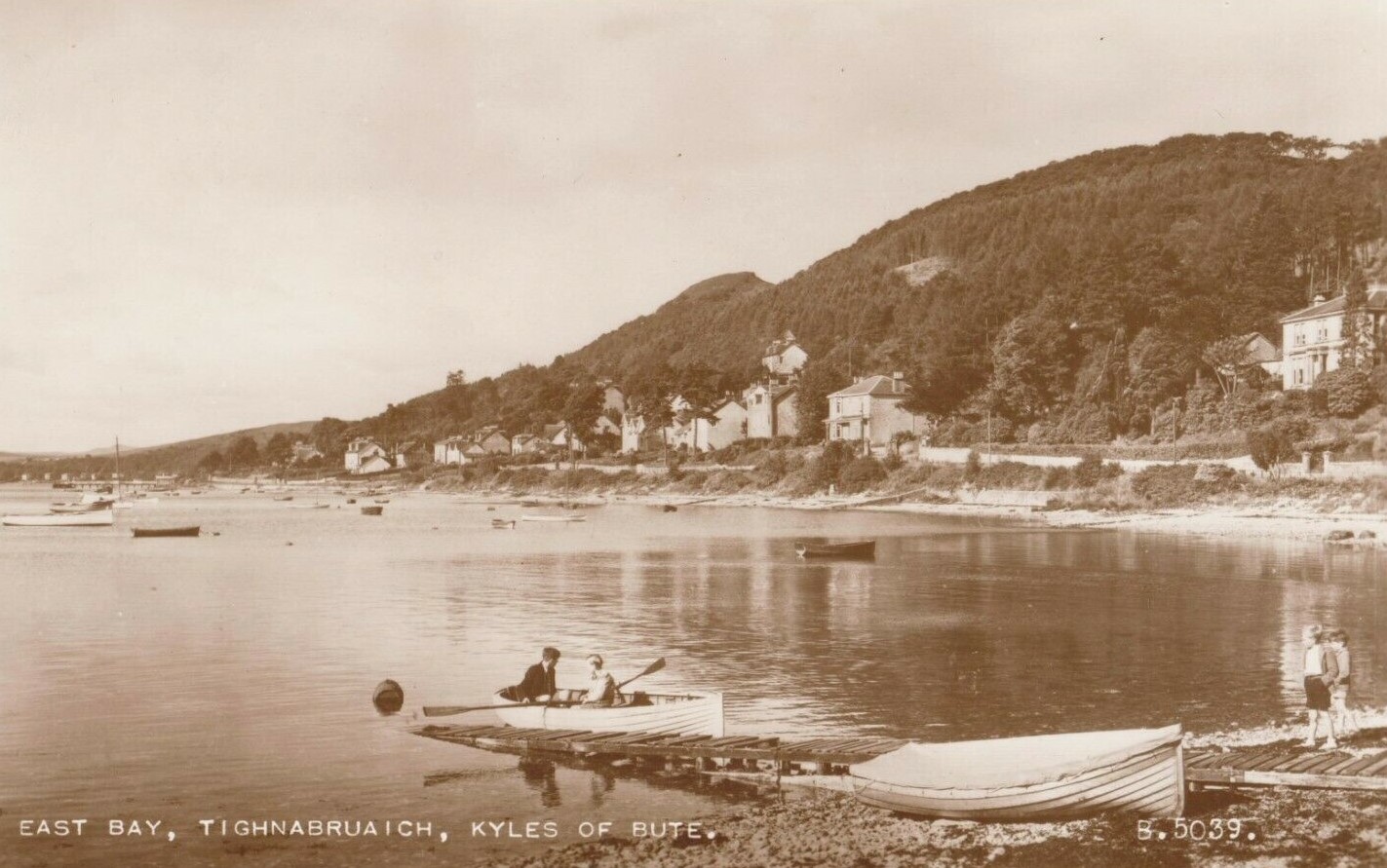
a postcard from Argyll

I have written here occasionally about my penchant for old postcards and have quite a few in my collection from the part of Argyll we’ll be exploring in our new club and forthcoming book.

Sometimes these postcards are as interesting for what’s depicted on the back as on the front.

It is also fascinating to see the same views presented, again and again, in different iterations.

Postcards are carriers of the nostalgia of visitors to, rather than the residents of, a landscape, and it is interesting how they become bound up in the meanings of a place. Such meanings are certainly at the heart of somewhere like Tighnabruaich, which didn’t really exist until the widespread sale of feus in the nineteenth century. A place which was effectively no-place before the wealthy commercial men of Glasgow began developing their second homes along the seashore, Tighnabruaich has perhaps always been a place of leisure, holidays, nostalgia.

And if postcards preserve, in the aspic of nostalgia, the relatively recent human history of places, they also commemorate things and spaces which are no longer in existence.

Glen Caladh was developed by the civil engineer, George Stephenson (1819-1905) (nephew of the famous ‘rocket’ Stephenson). Like his uncle, the younger Stephenson’s business was engineering, and he was involved in the design of several important railways and bridges (including the Sutton swing bridge, and the Victoria tubular bridge in Montreal). A keen sailor, Stephenson appreciated the good anchorage and easy connections of the Kyles of Bute. At Caladh (Gaelic for harbour, or haven) he built a large castellated villa of his own design.

Caladh’s interiors included costly novelties, such as a lavishly decorated mahogany dining room with a Robinson Crusoe theme, and maple carvings depicting scenes from Tam o’Shanter. The Stephensons then sold the Caladh estate to another nineteenth-century industrial family, the Ingham-Clarks: manufacturers of varnishes and paints.

At Caladh, the Ingham-Clarks’ hospitality became renowned. The family entertained wealthy industrialists and, later, early film stars – all of whom travelled to Caladh by water (there being, then as now, no access by road). Locals would occasionally spot celebrities being transported to the castle by the local “bum boat” from Tighnabruaich.

During the Second World War, Caladh, like so many Argyll estates, was subject to military commission. The quiet beaches, lochs, and coastline around the Kyles of Bute were ideal for naval training purposes, and in 1942 Glen Caladh Castle became HMS James Cook. Officers were stationed in the castle building, and 50 Wrens lived in a group of Nissen huts hastily erected in the grounds of the estate. A beach pilotage school was established, and crews were trained in the operation of landing craft that were later used in the D Day operations. After the war, the estate fell into disrepair, and Stephenson’s grand building was finally demolished as part of a territorial training exercise in 1960.

Today, as you sail or kayak around the Kyles of Bute, you might pause for lunch on Eilean Dubh, the burial island of the Ingham-Clarks. Or you might walk from Tighnabruaich as far as the tiny Caladh lighthouse, whose beacon once guided visitors to the estate, as they arrived by water.

If you know where to look, you can take a well-worn path into the hills behind where the castle once stood. And if you know how to read the stones and plants along this path, you might trace the story of the Victorian shaping of this landscape, before coming across the estate’s old lily pond.

But how do we understand a place when it apparently reveals so few clues of its important past? How do we learn about the story of a landscape when there might seem to be not much to see? What layers of history lie forgotten in the natural and built environment of contemporary Argyll? And what should we perhaps now try to remember?

These are the kinds of questions we’ll be asking as we explore the fascinating and often surprising history of Argyll’s Secret Coast through essays, photography, designs (and some local food and recipes as well). Tom and I will be joined on our journey by expert contributors Gilbert Márkus, Stephen Mullen, and Alex Hale, as well as talented local writers Michael Hartley and Jamie Stewart Lloyd Jones. Will you join us?

Club sign-ups are open until January 6th.


Discover more from Kate Davies

Subscribe to get the latest posts sent to your email.


Comments

14 responses to “a postcard from Argyll”

  1. Janet Clement Avatar
    Janet Clement

    The first time I visited beautiful Loch Fyne was with a postcard in hand, a postcard sent to my grandmother in the 1930’s by her cousin, Mary. It was a view of the main (only?) street in Furnace with an “x” marking her cottage. I showed the postcard to the postmaster/barkeep/hotel owner, thinking he might be interested in a small slice of local history. He immediately said, “Ah, I remember, Mary!” And, then added, “Her nieces live just down the road, I’ll ring them up for you.” What followed was an afternoon in front of a peat fireplace, sipping tea, and comparing family histories. I had grown up on stories about my Campbell/Blieu ancestry, but was unprepared with the immediate affinity I felt when I visited Scotland after two years of living, working and touring Europe. As a result of my visit, Dad and Mom visited Dad’s cousins in Furnace. I treasure the photo of him with Loch Fyne sparkling against a brilliant blue sky behind him. One thing I know is that my great-grandparents did not willingly leave such a perfect place behind. I’ve been to Argyll two more times, and look forward to exploring its “Secret Coast” with you, KDD.

    1. How wonderful to be able to catch up with your past in this way, Mary – and what a wonderful welcome you had in Furnace. We look forward to taking you (virtually) back to Loch Fyne in the club!

  2. Lovely to read this on Christmas Day while relaxing after a casual lunch at the beach and a swim. My Nana was born in Tignabruich in the late 19th century, so thank you so much for the postcards. Looking forward to immersing myself in all things Argyll when the club begins. Best wishes to you.

  3. Beautiful postcards and will really enjoy the the book!

  4. In the 3rd volume of Shetland Wool Adventures Journal, there’s an article about the light houses built on Shetland. Robert Stephenson was the first engineer, 1772-1850 and 2 more generations continued building them. Might they be related to your line of Stephenson’s? Or perhaps it’s a common name – but that’s a lot of engineers in Scotland.

    1. these are different Stevensons – with a v- it is certainly a common Scottish name (in both spellings)

  5. Margaret Anderson Avatar
    Margaret Anderson

    I THINK YOU MIGHT LIKE THIS

    Mr and Mrs Scotland Are Dead, by Kathleen Jamie
    Mr and Mrs Scotland Are Dead
    On the civic amenity landfill site,
    the coup, the dump beyond the cemetery
    and the 30-mile-an-hour sign, her stiff
    old ladies’ bags, open mouthed, spew
    postcards sent from small Scots towns
    in 1960: Peebles, Largs, the rock-gardens
    of Carnoustie, tinted in the dirt.
    Mr and Mrs Scotland, here is the hand you were dealt:
    fair but cool, showery but nevertheless,
    Jean asks kindly; the lovely scenery;
    in careful school-room script –
    The Beltane Queen was crowned today.
    But Mr and Mrs Scotland are dead.

    Couldn’t he have burned them? Released
    in a grey curl of smoke
    this pattern for a cable knit? Or this:
    tossed between a toppled fridge
    and sweet-stinking anorak: Dictionary for Mothers
    M:- Milk, the woman who worries?;
    And here, Mr Scotland’s John Bull Puncture Repair Kit;
    those days when he knew intimately
    the thin roads of his country, hedgerows
    hanged with small black brambles’ hearts;
    and here, for God’s sake, his last few joiners’ tools,
    SCOTLAND, SCOTLAND, stamped on their tired handles.

    Do we take them? Before the bulldozer comes
    to make more room, to shove aside
    his shaving brush, her button tin.
    Do we save this toolbox, these old-fashioned views
    addressed, after all, to Mr and Mrs Scotland?
    Should we reach and take them? And then?
    Forget them, till that person enters
    our silent house, begins to open
    to the light our kitchen drawers,
    and performs for us this perfunctory rite:
    the sweeping up, the turning out.

    From Mr and Mrs Scotland Are Dead, by Kathleen Jamie
    Copyright © Kathleen Jamie, 2002

  6. Christine Allport Tinker Avatar
    Christine Allport Tinker

    Kate what a wonderful experience your club offers. I am no longer able to kit very much because of arthritis, but the patterns sound fascinating. During the war years I lived with my grandparents on the isle of Bute and find the “club” fascinating. Can. someone like me no longer able to knit anything more than very basic blocks essentially join the club. I am so interested in your writing about Argyll. I read and enjoy all your newsletters. Seasons Greetings and a peaceful and healthy New Year, Christine

    1. Christine, I think (hope) you’d enjoy the essays and recipes in the club just as much – or more – than the patterns? One of our writers grew up on Bute, and we have another club piece exploring the wartime story of the area. Enjoy the festive season, look after your hands, and don’t do too much knitting! x

      1. Christine Tinker Avatar
        Christine Tinker

        Kate thank you for your reply I will be registering for the Club and am very excited . I am constantly amazed at the amount of time and work you put into these projects and appreciate your commitment to yarn, knitting, history, and the.inclusion of a diverse gathering of artists, writers, wide range of professionals, photographers and other resources. I always have to share photos and articles on the dogs with my husband, and he is a fan of Tom’s photography (as am I). May you and Tom enjoy Hogmanay. and welcome 2022 and may it bring good health, peace and adventure.

        1. thank you, Christine – and many good wishes for 2022!

  7. Susan Blake Avatar
    Susan Blake

    So happy I joined club on day one. This is a wonderful teaser.

  8. So excited for the start of this club! The post cards are tantalizing.

  9. Jeanne Adam Avatar
    Jeanne Adam

    Me too, I have been interested in old postcards for many years and have a small collection.
    I favour postcards from the various places where I have lived over the years.
    In my younger days I was a fan of the Picturegoer magazine, so collect film star cards of the 50/60’s . Also
    another interest of mine is the Royal family going back through history
    It is an addictive hobby but one that teaches you an awful lot about the past.
    The back of the postcards is, as you say, sometimes as interesting as the front.
    Thank you for sharing yours with us.
    Happy Christmas Kate and to all your staff.
    Sincerely Jeanne Adam

Leave a Reply to Christine Tinker Cancel reply

Your email address will not be published. Required fields are marked *