Sixareen Cape

While we were in the Highlands, we took the opportunity to photograph a design I’ve had ready for a while: the Sixareen Cape.

sixareenfulllength

I started knitting this Fair Isle wrap last October. You may remember that at that time I’d just designed a hat especially for Shetland wool week (The Sixareen Kep) using Jamieson and Smith’s wonderful Shetland Heritage Yarn.

kdworkshop1
(Sixareen Kep at my Shetland Wool Week Workshop, modelled by Tania Ashton-Jones. Photo courtesy Charlotte Monckton)

Around that time, I was getting a lot of wear out of a circular wrap I’d purchased from Toast (which I am wearing in the photograph above). This wrap was a sort of deep tube with raglan shaping, and I was surprised at how versatile a thing it was. It was a scarf, a cowl, a snood, and very nearly a sweater. I wore it scrunched up inside a coat when I was outside walking Bruce, I wore it wrapped about me inside the house when I needed another layer, and I wore it thrown on over a suit jacket when a little extra warmth was required outside. I liked it so much that I decided to design my own version featuring a deep Fair Isle border of the same chart design I’d used for the Kep, which I’d been very pleased with. This was the result.

sixareenclose

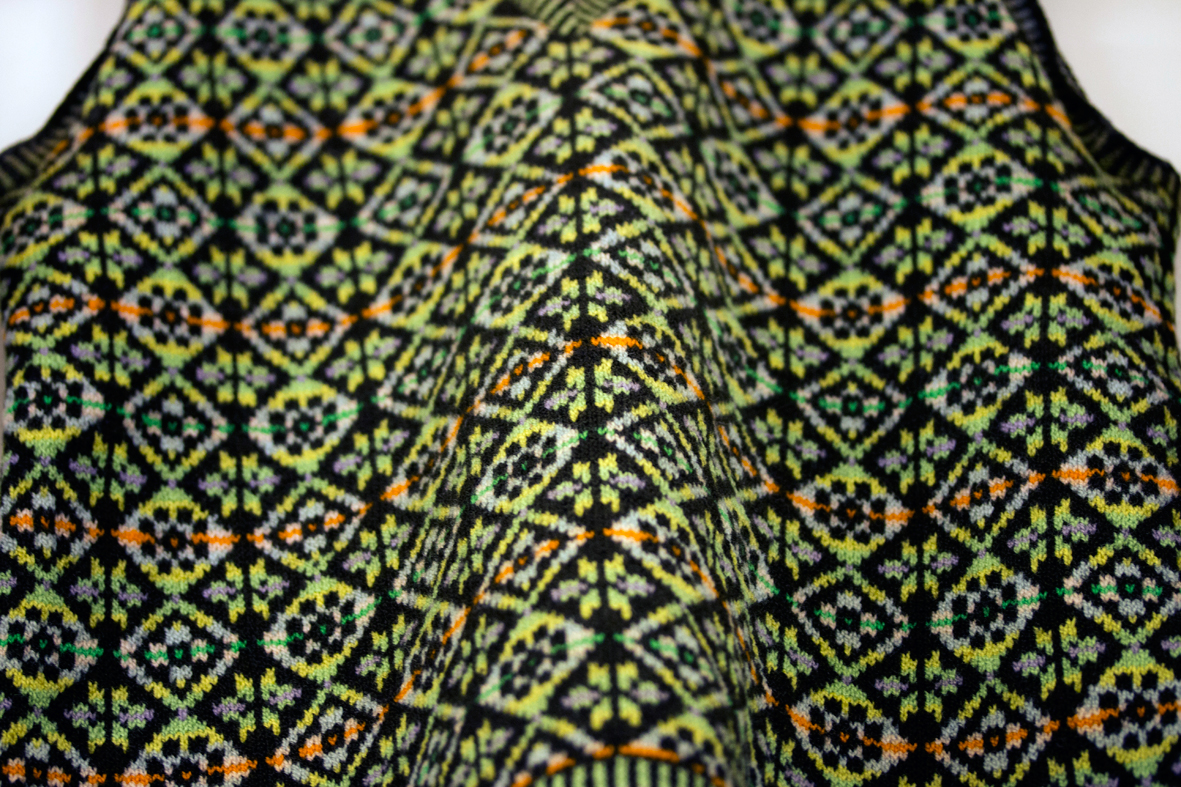
The border of the circularly-knit ‘cape’ features three repeats of the ‘kep’ chart. Its a design I’ve come across in several Shetland sources, and, if you look at it, you’ll see that it is an interestingly stretched-out and squashed incarnation of a traditional OXO motif. There are several things I find really pleasing about this chart. The background is unusually spacious for a Fair Isle motif (there are stretches of 7 stitches in some places), and there’s something about this space that allows the different shades to sing. Because of this, when repeated, the motif develops a shimmering near-kaleidoscopic quality, which I really love.

tworepeats

The heritage yarn is amazingly soft, and wonderful to work with. It is the perfect yarn for traditional Fair Isle, but it also has a marvelous drapey quality which makes it absolutely ideal for this kind of garment. The plain stockinette portion is knitted at a slightly looser gauge to enhance the drape, allowing the garment to be worn in several different ways.

It can be worn scrunched up, cowl-like around the neck . . .

sixareen

Pulled forward, collar-like, around the shoulders . . .

sixareenfrombehind

Or pulled down, cape-like, around the torso . . .

sixareenadjusting

Decreases are worked through the plain stockinette part of the garment in exactly the same way as the shaping of a raglan sweater.

sixareenfromabove

. . . and the end result is a striking and versatile wrap that is also great at warding off chilly highland breezes.

sixareenlandscape

These photographs were taken above Rannoch Moor on a truly beautiful evening.

sixareenflare

The cape comes in seven sizes, with a circumference of 45″ to 59″. It is fitted by measuring the wearer’s total shoulder circumference, and it should be worn with at least 2 inches of positive ease, to allow the wearing of layers underneath. If you would prefer a deeper or shallower wrap, the length is easily adjusted following the instructions in the pattern.

The Sixareen Cape is now available to purchase digitally through Ravelry and you can also purchase the pattern in print, to be shipped directly to you, (wherever in the world you are) via my Mag Cloud store.

thinking time

lerwick

Well, I had a fantastic time in Shetland. As I was on my own, I stayed in Lerwick. I really enjoyed meeting up with Shetland friends old and new, and pottering about toon.

commercialst

shutters

lodberrie

stoneandwater

But I was there to work — I have a couple of writing commissions in the pipeline, one of which involves producing a short history of Fair Isle knitting for a new (and very exciting) book about Shetland textiles. So I examined a lot of Fair Isle pieces, and I thought a lot about them.

fairislefromfairisle

I saw some truly incredible textiles . . .

checkerboard

. . . so many of which defied any idea of the ‘traditional’ in Fair Isle knitting.

silkandwool

(This striking allover features 4 shades of Shetland wool and 3 shades of artificial silk)

motifs
(Fair Isle motifs, but not Fair Isle knitting)

plaid
(Fair Isle or . . .Tartan?)

So much to think about.

me

Ursula Cardigan

Its time to show you another design, from the next of my Shetland ‘colour stories’. This is the Ursula Cardigan.

This design is named for writer and naturalist, Ursula Venables, who lived and worked in Shetland during the 1940s and ’50s. (You can read more about her in my book.)

Ursula’s writing about wildflowers, as well as my own experience of Shetland’s luminous summer landscape, provided the very feminine palette of this colour story.

While the distinctive zigzagging stitch pattern was inspired by a striking 1940s knitted garment I noticed very briefly on screen in a BBC drama.

This cardigan is probably the most ‘challenging’ design in Colours of Shetland, but that doesn’t mean it can’t be tackled by a confident beginner. It is knit in the round, with steek bridges placed for the front openings and armscyes. After knitting the body, the armscye steeks are cut, and the sleeves are worked top-down in Barbara Walker fashion.

The front steek is cut, and lined with a pretty ribbon trim.

Vintage glass buttons provide the perfect finish. . .

. . .and snaps are used in place of holes to help the button bands retain their shape over time.

This is a classic garment, that, if made carefully, should see its wearer through many summers.

We shot these photographs near St Ninian’s Isle, in Shetland’s South mainland. Every time I look at them, I long to be back there again.

I think I’ll take the Ursula cardigan back to Shetland again next year, to enjoy some more glorious summer days.

Yarn requirements and sizing information for the Ursula Cardigan can now be found on Ravelry.

rams and yowes

Hmmm . . . do I spy . . . some sheep?

. . . . many sheep?

. . . and many rams?

120 yowes and 48 rams?!!

Yes! It’s the rams and yowes lap blanket!

In case you were wondering, yowe means ewe in Shetland dialect and, just like the sheepheid design from which it emerged, the rams and yowes blanket is a celebration of the many-hued variety of Shetland sheep. The blanket uses all 9 natural shades of Jamieson & Smith Supreme jumper weight, and it is very simple to make: the body of the blanket is first knit up as a steeked, colourwork tube. When the colourwork is complete, the steek is cut, and stitches are picked up for the garter stitch edging. Increases and decreases create mitred corners, which fold to the back of the work, creating a neat facing inside which the steek is completely hidden. If you have never steeked before, this would be a good first project to try out the technique.

Here is the facing from the back with the steek hidden inside. To my mind, there are few things more lovely than graded shades of natural Shetland worked in garter stitch. So very pleasing!

Can you tell that I am stupidly happy with this design?

I love the way that the 120 yowes, worked in the graded Shetland shades, give the effect of a massive, ever-receding flock, and the rams lend a graphic, carpet-like aspect to the blanket’s centre

The finished blanket measures 3 feet square. It is just the right size for draping over your knees, or the back of the sofa, and can also be worn as a very cosy wrap or shawl.


The rams and yowes pattern has been expertly test-knitted by my friend Sarah (thankyou, Sarah!). If you’d like to make your own, the pattern is now up and available here, or here.

And in case you are wondering about my hand wear – yes, those are a pair of Muckle Mitts that I whipped up yesterday from a lovely free pattern – a new year’s treat from (who else?) Mary Jane Mucklestone – go and download yourself a copy!

I want to bob my hair . . .


Stanley Cursiter The Fair Isle Jumper (1923) Edinburgh City Art Centre

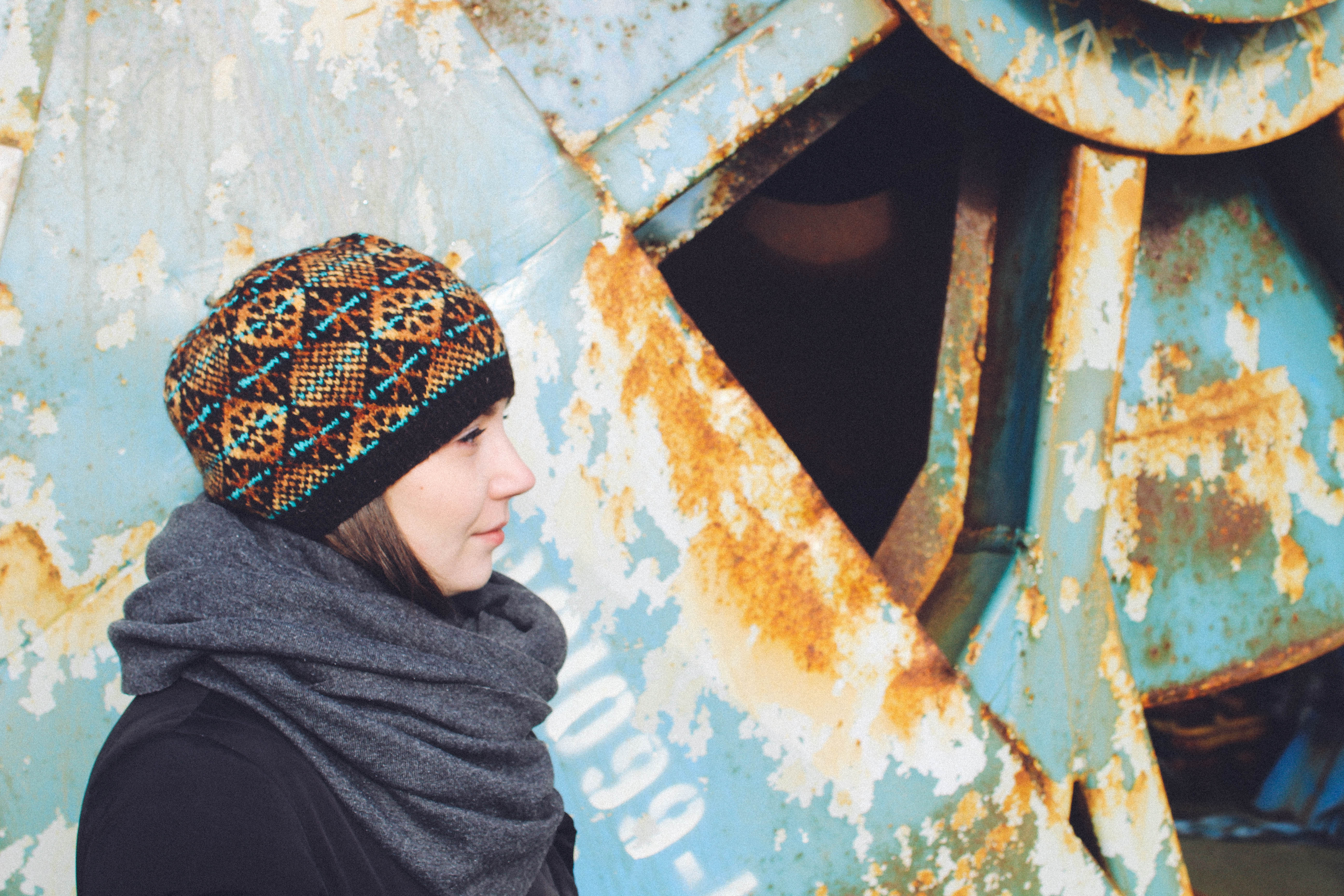
. . . just to wear this hat. I have 1920s accessories on the brain at the moment – we watched Anthony Asquith’s brilliant A Cottage on Dartmoor a few days ago, in which, between manicures, Norah Baring was sporting some fantastic hats in similar style. (Quite apart from its fashionable headgear, the film – a melodramatic paean to the power of silent cinema – is highly recommended).

wwwwo #1

headband2

I’ve written up the pattern for this wee headband — item #1 in wazz’s woollen winter walking outfit (wwwwo for short). The pattern is very simple — just a single large star repeat — certainly suitable as a first colourwork project for those who’ve not tried the technique before. You’ll need springy fingering-weight yarn in five different shades for the colourwork, and a small amount of a softer laceweight/ fingering-weight yarn for the lining. My lining yarn is Orkney Angora 4 ply, and the colourwork uses 5 shades of the Alice Starmore Hebridean 2ply: Selkie, Machair, Dulse, Pebble Beach, and Solan Goose. You know how I love this yarn: it knits up incredibly evenly and the colours are amazing. The lining is knit first, beginning with a provisional cast on, which is unzipped and knitted-in with the top edge of the headband once the colourwork is complete. Both edges are neatly (and predictably) finished with applied i-cord: on the bottom edge, you pick up stitches across the row of purl bumps (along which the lining is turned up), before binding off in i-cord. I tend to make i-cord quite tightly, so bound off on a larger needle to prevent the headband drawing in too much. (This may not be the same for everyone, so do bear this in mind.)

I feel that my compulsion to finish all knitted edges with icord follows the same irresistible impulse I had when drawing as a child: viz, to outline everything with strong, bold lines. My teachers repeatedly criticised me for this in school: but no-one has said anything about the potentially infantile nature of my i-cord compulsion . . . yet . . . In fact, I’d go so far as to say that my i-cord obsession has deepened since I discovered the sheer wonder that is the i-cord buttonhole. I get very frustrated with some buttonholes in knitted fabric — they can just look so poxy and untidy — but not so the i-cord buttonhole! It is, without a doubt, the neatest and most satisfying buttonhole I’ve ever come across. My current (and almost-complete) project features i-cord buttonholes and, additionally, almost 600 continuous stitches of i-cord. Imagine! i-cord heaven! I can hardly contain myself! More soon.

Anyway, if you fancy knitting an angora-lined, i-cord outlined headband for yourself, you can find the free download link over here on the designs page. Enjoy!

headband1

paper dolls

paperdoll

I’m glad the early mornings are becoming lighter, otherwise I (or rather, Tom) wouldn’t have been able to take these speedily snapped shots of my new sweater. Spring is definitely on its way . . .

paperdollback

Did I mention that, undoubted tweeness notwithstanding, I heart this sweater? I love the velvety braf yarn (particularly the semi-solid pale blue colourway I used for the corrugated rib). I love the ridiculous dancing doll figures (a modified version of a chart in the 1950 edition of my trusty Odham’s Encyclopedia of Knitting). I love the icord edging (O the wonder of producing that edge from those three knit stitches!). I love the light feel of the sweater (the yardage of bowmont braf is pretty amazing — even with the doubled-layers of the stranding and corrugated rib, this sweater weighs just 160 grams); I love the colourwork (wot fun it is) and, well, you probably know already that I love anything with a yoke. . .

paperdollyoke

In fact, the only shortcoming of this sweater (for me at least) is that there are a couple of places where my blue weaves show slightly through the cream fabric on the front. The legs of the dolls are 11 stitches apart — too far to carry the yarn — but if I knit the yoke again, I think I may manage to avoid this by alternating the spots where I place the weaves, rather than stacking them up (silly me). Still, I am really pleased with the general structure of the yoke, and with the effect of the colourwork overall.

paperdollside

The basic design of the yoke is a bit like the owl sweater, in that there are no decreases until 4 inches have been worked. But the back of the neck (which you can see here) is more structured and shaped than the owls, using a gazillion short rows, which I have hopefully calculated correctly. There is also some gentle waist shaping, but no bust darts. I am going to wear this lots this Spring! Now I just have to write up the pattern. . . .

Pattern: Paper Dolls (by me)
Yarn: Bowmont braf 4 ply in natural, indigo, and ‘ocean mist’
Needles: 3mm circ
Ravelled here

Oh, and here’s some obligatory throwing of shapes. . . .

3292658762_23c2054172

EDIT! Pattern is now available here

Follow

Get every new post delivered to your Inbox.

Join 3,971 other followers