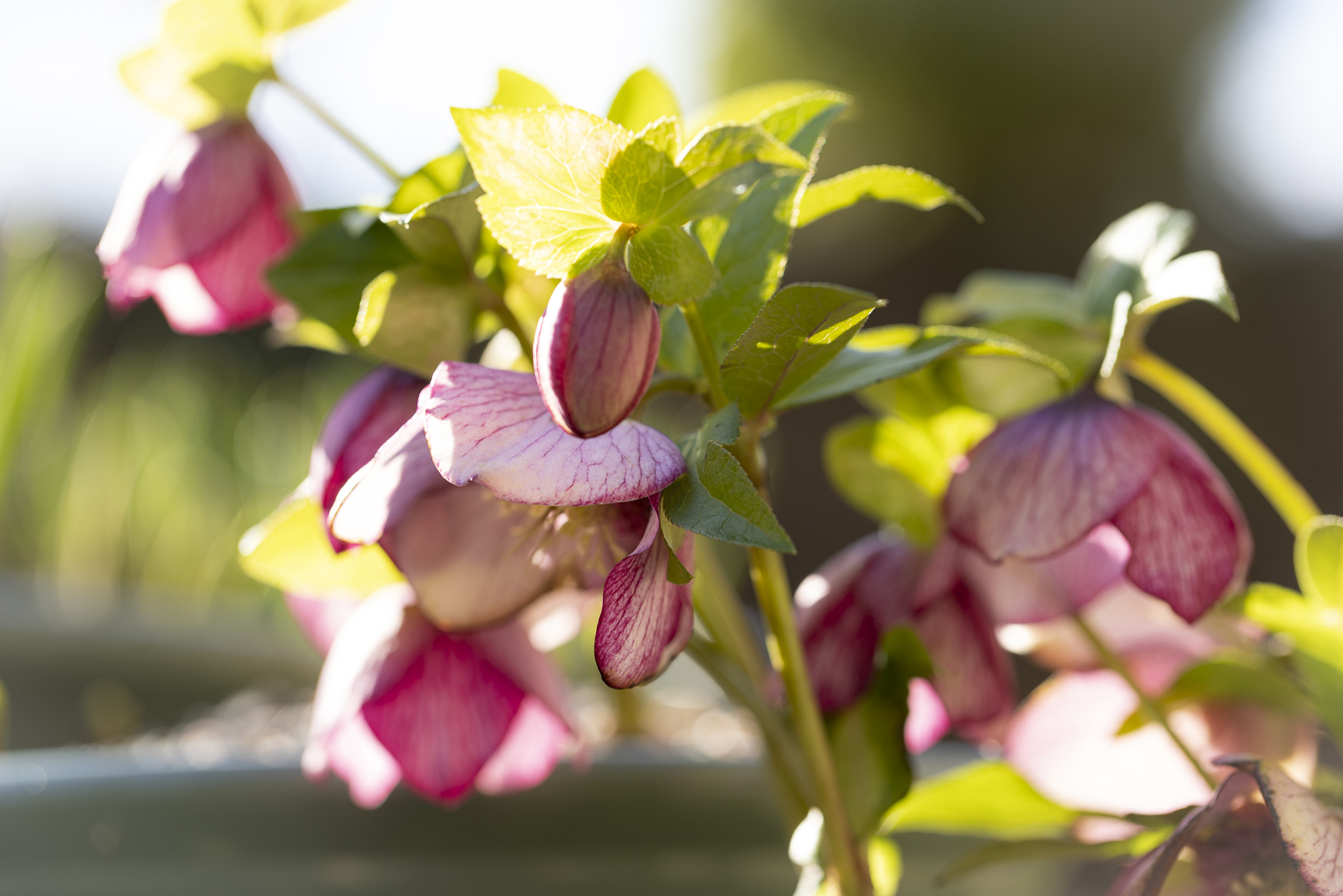
Close-up of pink flowers with green leaves, illuminated by sunlight.

One of the things I love about gardening is the experience it enables of what Buddhists refer to as Beginner’s Mind: I am very much a beginner gardener, and the fact that I inherited my garden means that, over the past two years, I’ve often found myself in a state of confused un-knowing, having to learn about a particular plant and how to care for it. This process is a very rewarding way of gaining knowledge: you begin in a place of complete ignorance, but a bit of practical effort can see even the most rookie gardening efforts quickly beginning to pay off.

A close-up of a single pink and white flower with small dark speckles, surrounded by green foliage.

Hellebores are a case in point. I have always been a fan of this star of the February / March garden.  I find their muted colours – all soft, greenish pinks and greyed-out plums – powerfully suggestive of the transitional edge of winter and the quiet promise of spring.  I had admired these lovely flowers, but, until we moved to Kintyre, had never grown them. 

Close-up of a soft pink flower with a pale center and numerous stamens, set against a bright, light background.

I was thrilled to find that many different hellebores had been planted all over the mill garden. Last year I learned how taking the old leaves off can really help these evergreen plants to thrive. I did this in two stages, removing any brown-ish leaves in autumn, and all of the previous year’s leaves when the crowns really got going in February. My reward has been beautiful healthy clumps of hellebores, delighting the eye and lifting the spirits as they nod in the early spring sunshine. 

A cluster of pale pink flowers surrounded by green leaves, illuminated by sunlight in a natural garden setting.

In learning how to care for my hellebores, I also began to really look at them as a beginner gardener does, with an eye both appreciative and curious. For example, I hadn’t noticed until I began my February leaf-trimming rounds that this gorgeous pale pink cultivar has just four petals (actually sepals, but we’ll come to that later) while all the other cultivars in the mill garden have five

Close-up of soft pink flowers with delicate petals and green leaves against a light background.

So then, of course, I had to go away and read about hellebore species and cultivars, their propensity to hybridise, their many differences . . .

Close-up of a pink flower with delicate petals and green leaves in soft focus.

Trying (in vain, it must be said) to figure out which hybrids were growing in the garden made me examine each individual plant much more closely. And what I found when I looked inside the hellebore flowers was very interesting. . . 

Close-up of three beautiful hellebore flowers with pale yellow petals and deep pink speckles, set against a soft blurred background.

. . . because surrounding the stamens and anthers was a curious ring of flattened tubular structures. I had no idea what these tubes were . . . 

Close-up of two hellebore flowers with pale green petals and deep pink speckles, showcasing their intricate structure and details against a blurred background.

. . . but I noticed that when a flower was in full bloom, the tubes were open . . .

Close-up of a pink and white flower with prominent yellow stamens and speckled petals.

 . . . and when the flower passed its peak, that they began to close . . . 

Close-up of a pink flower with a spotted pattern on its petals and visible stamens.

. . .eventually closing entirely . . .

Close-up of a hellebore flower, featuring deep maroon petals and yellow stamens, alongside a budding flower and green leaves.

. . .  and being replaced by a developing seedhead. 

Close-up of a pink and cream speckled flower with greenish-yellow center, surrounded by buds.

My botanical knowledge is minimal, but by reading Graham Rice’s books about hellebores (available on on archive.org)  I discovered that these tubes are what is known as nectaries: a delicious invitation to any insect waking up after a long winter to pay the hellebore a visit and assist with pollination. 

Close-up of a pink hellebore flower with intricate speckled patterns and green stamens against a blurred background.

I also came across this interesting research about what makes the nectaries of hellebores particularly attractive to any insect who is brave enough to buzz about on a chilly February day: the nectar the flowers produce is rich in yeast, which generates heat as it ferments. While the muted colours of the flowers which I find so pleasing are not particularly appealing to bees, this heated nectar makes the hellebores an unusually attractive pollinator prospect.

Close-up of a pink hellebore flower with prominent yellow-green stamens and dark speckles on the petals.

Hellebores effectively invite pollinators in for a delicious cup of hot chocolate on a cold winter’s day. 

Close-up of two pink flowers with spotted petals and green leaves.

Roll up, roll up! Hot nectar here! 

Close-up of a flower with intricate light yellow petals featuring maroon speckles and a central cluster of green stamens and white filaments.

Hot beverages for bees! Hot beverages for bees! 

Close-up of a pink hellebore flower with speckled petals and a yellow center surrounded by green leaves.

It was at this point, as I regaled him with countless factoids, that Tom suggested I might be in danger of becoming a helle-bore. For example, their petals are not actually petals but sepals and hellebore nectaries aren’t conventional nectaries at all but are rather a very particular kind of petal, something petaloid . . . 

Close-up of a pink and white flower with prominent yellow stamens against a light background.

“Isn’t that interesting?” I said to Tom “and look, the light is nice. A good time to get outside and take some photos of those ruffly hellebores” 

Close-up of delicate flowers with pale yellow petals and pink edges, surrounded by green leaves.

“The ruffly hellebores?”

Close-up of a delicate white flower with soft pink edges and prominent yellow stamens, against a light background.

“Yes, the ones round the front. They are interesting because they are biologically recessive”

Close-up of delicate white and pale pink flowers with green foliage in a blurred background.


“biologically recessive?” 

Close-up of a pale pink flower with delicate petals and green leaves in the background.

“yes, they have been cultivated to have double flowers, which means that their petaloid nectaries have now become petals . . .”

Close-up of pale flowers with soft pink tips and green leaves.

“ . . . and because they don’t offer bees their tasty hot beverages, they are less attractive to pollinators, and are therefore much less effective at getting pollinated hence, they are biologically recessive”

Close-up of a soft, pale flower with frilled petals in shades of yellow and pink, surrounded by blurred greenery.

Uh-oh, have I helle-bored you too, dear reader? I do have more to say – about botanical illustration and its history –  but I’ll perhaps save that for another time. 

Close-up of a blooming flower with pale yellow petals and red speckles, set against a bright background.

In any case, the garden and its hellebores have really helped me this week. 

Close-up of a soft pink flower bud with delicate petals and a green stem, set against a blurred background.

Thank you, all of you, for your kind and supportive comments on my last post (which mean an awful lot to me). 

Close-up of a pale yellow flower with purple speckles and green centers, showcasing delicate petals and stamens.

I’ve been getting on with the book, as well as getting out in the garden, and I’m happy to say that we should be able to go to print fairly soon. More of this too, anon. 

Close-up of a pink flower with yellow and purple speckles, surrounded by green leaves and softly blurred background.

Enjoy your Sunday, whatever you are up to!


Discover more from Kate Davies

Subscribe to get the latest posts sent to your email.


Comments

14 responses to “Helle-bore”

  1. Anne Mc Avatar

    Thank you for a wonderful moment taking us through your garden to admire these delicate flowers. I enjoyed the educational narrative. Like you, I knew nothing about these beautiful plants. The photos were a joy to see. I am glad your garden is bringing you peace and happiness.

    Anne

  2. loudlyluckyddeb6f9d48 Avatar
    loudlyluckyddeb6f9d48

    Lovely, Kate! A favourite of mine, too, they\’re nodding to you from Sussex as I write.

    Marguerite

  3. Jenny Bruce Avatar
    Jenny Bruce

    What a beautiful essay I love hellebore’s too and they have arrived in my garden almost like magic. I sometimes feel they are so alone as nothing else is ready to make us feel like spring. I hope you are recovering even if it’s slow. It’s wonderful that you share your experience with the world. Currently knitting Glens. And have almost finished knitting Toraidh just the sleeves to go. Feel better. Jenny

    Jennifer Bruce

  4. Elizabeth Lane Avatar
    Elizabeth Lane

    I did not write after your last post, but was so relieved that you are feeling better. My garden doesn’t have the variety of hellebores yours does, but I am entranced with them! Thank you!

    >

  5. sue tulloch Avatar
    sue tulloch

    I\’m a helle-bore too Kate, such beautiful plants which even I can\’t  \’kill\’, they do so well here in West Cumbria. My favourite is the lime green Corsican hellebore, also known as stinking hellebore, although I don\’t think it smells of anything. I\’m so glad you are enjoying your beautiful garden and I hope you\’ve had some of this lovely weather this week. Sue

  6. inspiringb07bcdc4ac Avatar
    inspiringb07bcdc4ac

    I love your post on hellebores! I have some in my garden too and they make me so happy. I got them from plantsman Dave Hinkley at his old garden Herronswood on Bainbridge Island, and moved them with me to Spokane, Washington when I moved here 21 years ago. They are blooming now and give me more joy than just about any plant in the garden. Yours are so beautiful!

    I hope you are feeling better. ❤️ . ❤️

  7. Tracey Fine Avatar
    Tracey Fine

    Thank you, Kate! I love my hellebores, too.

  8. Karen Ferguson Avatar
    Karen Ferguson

    I was not helle-bored! I just “discovered” them this winter on a gardening blog, and plan to put them in a shady spot where nothing seems to grow. I am anxiously waiting for my garden store to open this week. I have this irrational fear that there will be a run on hellebores and none will be left by the time I arrive!

  9. debsielou72 Avatar
    debsielou72

    Oh I love this, thank you for sharing. Learning everything about something beautiful is such a good thing. Hope you are feeling on a more even keel.

    Brains are wonderful and complicated and the world we inhabit is limitless in inspiration.

    I wrote lots more but really what I wanted to say was trust what you know you need and delighting in detail is definitely encouraged here debs

  10. Ina Demmler Avatar
    Ina Demmler

    Liebe Kate, haben Sie vielen Dank für diesen schönen und überaus interessanten Bericht. Zwar besitze ich selbst nur zwei Blütenfarben, aber nun sehe ich diese Gewächse mit ganz anderen Augen. Es freut mich sehr, dass Christrosen so hilfreich für Bienen sind, das wusste ich bisher nicht. Alles Gute für Sie und Ihren Mann, herzliche Grüße von Ina aus Deutschland!

  11. Shelley Withers Avatar
    Shelley Withers

    I love them too. I have several of the pink plants. The bloom stays for such a nice long time, and restores my faith that spring is coming…. Even if we’re in for a massive snow storm here in Nova Scotia tonight.😊
    Shelley

  12. Carol Spence Avatar
    Carol Spence

    You are NOT a helle-bore. I’ve grown these plants for years and I did not know about the nectaries and their warm nectar. How very smart of them. Isn’t nature grand? Thank you for sharing what you’ve learned.

  13. Safirexx Avatar

    Oh Kate I loved this. You can helle-bore me away any time you choose! I also only discovered these fascinating plants last autumn when I was putting together a winter pot and came across the beautiful white Christmas Carol variety in my local garden centre. I have been hooked ever since.

    Now that I know what they are I\’ve been seeing them everywhere and feeling faintly astonished that I\’ve been walking around as one blind all these years! Well, I\’m glad I\’ve woken up to their charms at last – they have been the highlight of my February and a few varieties have found their way straight into my garden where I fully expect them to delight me for many years to come.

    Thanks for sharing the book as well. Even better that it\’s a freebie ??

    I\’m so glad you seem to be well on the road to recovery. Wishing you a speedy return to full health.

    Kind regards

    Ama

  14. speedycollection90f0e5186f Avatar
    speedycollection90f0e5186f

    Loved this post! Can’t wait to read more……

    Best wishes as you recover Jenny

Leave a Reply

Your email address will not be published. Required fields are marked *